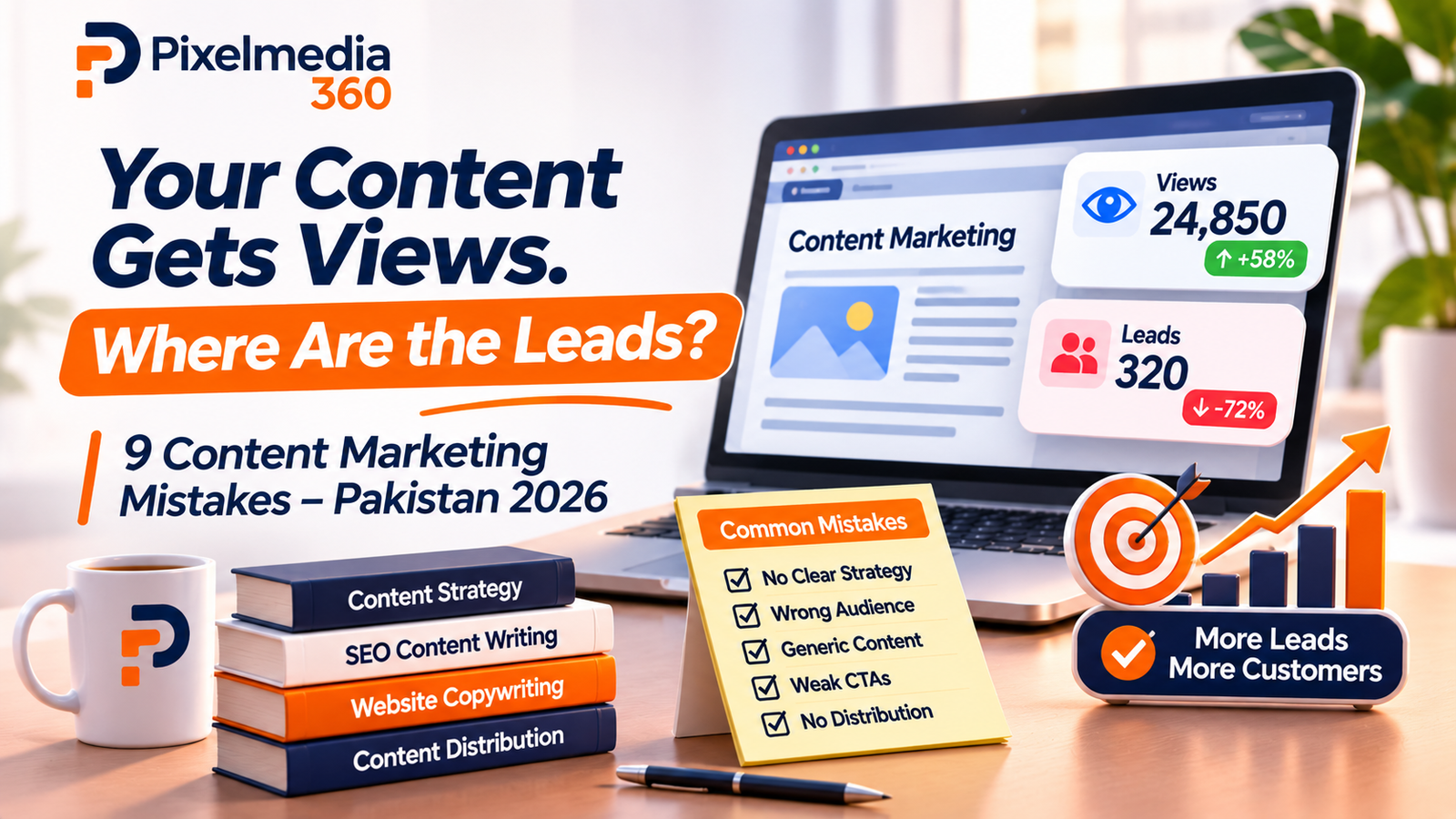
Your business publishes blog posts regularly. Your website attracts visitors, and your social media content receives engagement. However, enquiries remain limited, and your content rarely turns readers into potential customers.
This is one of the most common content marketing mistakes businesses need to investigate in 2026.
For Pakistani businesses, publishing more articles does not automatically translate into more leads. Effective content needs to reach the right audience, answer relevant questions, demonstrate credibility, and provide a clear next step.
Businesses in Islamabad, Rawalpindi, Lahore, Karachi, and across Pakistan can improve results by connecting content creation with customer needs and measurable marketing goals.
Professional content marketing services can help businesses build a structured approach rather than publishing without a clear strategy.
This guide explains nine content marketing mistakes that can reduce lead generation, their business impact, and practical ways to turn useful content into qualified enquiries.
Quick Answer: Why Is Your Content Marketing Not Generating Leads?
Content marketing may fail to generate leads when businesses target the wrong audience, publish generic articles, ignore search intent, or use weak calls to action. Poor internal linking, inconsistent distribution, and missing conversion tracking can also limit results. A customer-focused content strategy connects useful information with relevant services, trust signals, and measurable actions.
What Is Content Marketing and How Does It Generate Leads?
Content marketing is the planned creation and distribution of useful information designed to attract, educate, and engage a specific audience.
Unlike direct advertising, content marketing often helps potential customers understand a problem before choosing a product or service.
Common content formats include:
- SEO blog articles
- Website service pages
- Educational guides
- Social media content
- Product explanations
- Email newsletters
- Case studies
- Video tutorials
How Content Marketing Works
An effective content marketing strategy supports the customer’s buying journey.
A potential customer first discovers your content through Google, social media, email, or another channel.
They then evaluate the information and decide whether your business offers a relevant solution.
If your content answers their questions and establishes credibility, they may visit a service page, request a quotation, or contact your business.
The process can be summarized as:
Relevant Content → Customer Interest → Trust → Service Discovery → Qualified Enquiry
Who Needs Content Marketing in Pakistan?
Content marketing can support businesses across different industries.
An e-commerce store may publish buying guides and product comparisons.
A real estate company can explain purchasing procedures and market considerations.
An accounting firm may create educational articles addressing tax and bookkeeping questions.
A digital marketing agency can publish guides about SEO, advertising costs, website development, and lead generation.
The content must address the actual needs of the intended customer.
Why Content Marketing Matters for Pakistani Businesses in 2026
Customers often research businesses before contacting them.
A potential customer searching for website development services may compare providers, read guides, review portfolios, and investigate pricing.
Businesses that publish useful, accurate information can support this decision-making process.
However, digital competition also means that generic articles have limited differentiation.
Google’s content guidance emphasizes original information, clear purpose, relevant experience, and reliable explanations.
For businesses in Pakistan, the priority should be creating content that reflects local customer needs while providing genuine value.
For example, a Shopify development guide for Pakistani businesses may discuss payment methods, cash-on-delivery requirements, and shipping arrangements.
These details are more useful to the intended audience than generic information that ignores local operational challenges.
9 Content Marketing Mistakes That Prevent Lead Generation
1. Targeting Traffic Instead of Potential Customers
Problem: Businesses select keywords mainly because they have high search volumes.
For example, a marketing agency may publish broad technology articles that attract readers with no interest in hiring marketing services.
Business Impact: Website traffic increases, but enquiries remain limited.
Better Approach:
Focus on keywords that match your services and your customers’ problems.
A business offering website development might target topics such as:
- WordPress vs Shopify in Pakistan
- Website development cost in Pakistan
- How to choose a website development company
- Why business websites fail to generate leads
These subjects can support both customer education and commercial discovery.
Use Google Search Console to identify existing search queries and understand which pages attract relevant visitors.
2. Publishing Content Without a Clear Strategy
Problem: Businesses publish unrelated articles simply to maintain posting frequency.
One week, the blog discusses social media. The next article covers an unrelated trend, followed by another topic with little connection to the company’s services.
Business Impact: Content becomes difficult to organize, measure, and connect with customer enquiries.
Better Approach:
Develop a content strategy around your core services.
For example, a digital marketing agency might organize articles into SEO, Google Ads, social media, website development, and content marketing clusters.
Each cluster should address related customer questions.
Create a content calendar that identifies the target audience, search intent, primary topic, relevant service page, and conversion objective.
For a detailed planning framework, read our Content Marketing Strategy for Business Growth in 2026.
3. Ignoring Search Intent
Problem: The content does not match what users want to accomplish.
Someone searching for “what is content marketing” usually expects an explanation.
Someone searching for “content marketing agency in Islamabad” may want to evaluate a service provider.
Treating both queries identically can reduce the usefulness of your content.
Business Impact: Visitors may leave without finding the information they expected.
Better Approach:
Understand search intent before writing.
Informational content should provide direct answers and useful explanations.
Commercial content should help visitors compare solutions and understand service suitability.
Transactional pages should explain the offer and make the next step clear.
Match each article to a distinct purpose rather than forcing every keyword into one page.
4. Creating Generic or Low-Value AI Content
Problem: Businesses publish large quantities of AI-generated content without verifying accuracy or adding original information.
The articles may repeat common statements without providing practical examples, evidence, or relevant expertise.
Business Impact: Readers may find little reason to trust the content or choose the business.
Better Approach:
Use AI as an editorial support tool rather than a substitute for meaningful research.
Improve articles with:
- Original explanations
- Relevant examples
- Accurate sources
- Practical recommendations
- Real business experience
- Verified customer questions
- Clear editorial review
Google does not automatically penalize content because AI assisted its creation.
The issue arises when content provides little value or is produced primarily to manipulate search rankings.
The objective should be to publish useful, accurate information for real people.
5. Writing Blogs Without Clear Calls to Action
Problem: An article provides useful information but does not guide interested readers toward the next step.
For example, a business publishes an informative guide about Google Ads costs without linking to its advertising service page.
Business Impact: Potential customers may leave after reading rather than exploring relevant services.
Better Approach:
Add contextual calls to action where they serve the reader’s needs.
Examples include:
- Explore our content marketing services
- Request a website content assessment
- View our SEO services
- Book a marketing consultation
A content marketing guide should not repeat promotional messages in every section.
Instead, introduce a relevant service naturally after explaining the problem it helps address.
6. Neglecting Internal Linking
Problem: Blog articles are disconnected from related content and commercial service pages.
Readers may find useful information but struggle to discover additional resources or relevant business services.
Business Impact: The website misses opportunities to improve navigation and connect informational traffic with commercial pages.
Better Approach:
Link articles to relevant service pages and supporting guides.
For example, a blog about content marketing performance can link to professional SEO services when discussing organic search optimization.
Use descriptive anchor text that reflects the linked page.
Avoid adding links solely to reach a fixed number.
Internal links should make the website easier to explore.
7. Ignoring Content Distribution
Problem: Businesses publish an article and assume potential customers will automatically discover it.
Even a useful article may receive limited attention when the website has low search visibility or the content is not promoted through relevant channels.
Business Impact: Valuable content reaches fewer potential customers.
Better Approach:
Develop a distribution process for important content.
A blog article may be adapted into LinkedIn posts, Instagram carousels, short videos, or email content.
For example, an article about content marketing mistakes could become a short educational Reel explaining three common problems.
A longer LinkedIn post could discuss how businesses measure content-generated enquiries.
Distribution should match the intended audience and platform rather than copying identical messages everywhere.
Our Social Media Content Strategy in Pakistan 2026 explains how businesses can plan content around audience needs.
8. Publishing Content Without Building Trust
Problem: Business articles contain broad claims but provide limited evidence of expertise or practical experience.
Readers may struggle to determine whether the advice is reliable.
Business Impact: Potential customers may hesitate to contact the company.
Better Approach:
Support important claims with credible sources and accurate explanations.
Where appropriate, include genuine project examples, author information, relevant experience, and original observations.
For service-related articles, clearly explain the process and the factors that influence results.
Avoid invented case studies, unsupported statistics, and guaranteed rankings or sales claims.
Trust develops when businesses provide useful information consistently and transparently.
9. Measuring Content Success Through Traffic Alone
Problem: Businesses evaluate blog performance using page views and impressions without measuring enquiries or other meaningful customer actions.
Business Impact: High-traffic content may be mistaken for commercially successful content.
Better Approach:
Track performance throughout the customer journey.
Use Google Search Console to evaluate organic search visibility.
Use Google Analytics 4 to measure relevant website actions, including completed enquiry submissions and other configured key events.
Monitor metrics such as:
- Organic clicks
- Relevant search queries
- Landing-page engagement
- Service-page visits
- Qualified enquiries
- Content-assisted conversions
- Customer acquisition costs
A blog generating fewer visits may deliver more business value if it attracts customers with stronger commercial intent.
How to Build a Content Marketing Strategy That Generates Leads
Fixing individual mistakes is important, but businesses also need a structured plan.
Step 1: Define Your Ideal Customer
Identify the audience you want to attract.
Document customer problems, purchasing concerns, geographic requirements, and common questions.
Step 2: Map Content to the Buying Journey
Develop content for awareness, consideration, and decision-making.
Educational articles can explain problems, while comparisons and service pages help customers evaluate solutions.
Step 3: Conduct Keyword Research
Use relevant search queries to identify topics your potential customers are researching.
Consider search intent and commercial relevance rather than focusing only on search volume.
Step 4: Create Original and Helpful Content
Publish information that answers customer questions accurately.
Include practical examples, clear explanations, and trustworthy references.
Step 5: Connect Content Through Internal Links
Link supporting articles to relevant service pages and related guides.
Ensure navigation remains logical.
Step 6: Optimize Conversion Opportunities
Use clear calls to action, relevant landing pages, and accessible contact forms.
Make it easy for interested readers to request more information.
Step 7: Distribute Your Content
Adapt useful articles into social media posts, videos, email content, and other relevant formats.
Step 8: Track Performance
Review organic visibility, engagement, enquiries, and conversion quality.
Use these findings to improve existing content and refine future topics.
How Much Does Content Marketing Cost in Pakistan in 2026?
Content marketing costs in Pakistan vary according to research requirements, content length, industry complexity, production formats, and ongoing management.
Publicly advertised Pakistani agency packages show substantial price differences.
For example, published content marketing packages include four-article monthly plans priced around PKR 24,000–30,000, while broader strategy-led retainers start at approximately PKR 65,000 and can exceed PKR 100,000 monthly.
These are individual providers’ advertised prices, not official industry averages.
Indicative Content Marketing Costs
| Service | Illustrative Price |
| SEO blog article | PKR 3,000–20,000 per article |
| Monthly blog package | PKR 24,000–70,000 |
| Strategy-led content retainer | PKR 65,000–150,000+ |
| Comprehensive multi-format marketing | Quoted according to scope |
These figures reflect examples from publicly advertised Pakistan-market pricing and are not Pixel Media 360’s official rates.
What Affects Content Marketing Pricing?
Research depth: Technical and specialized subjects may require more time and expert review.
Content volume: Producing multiple articles or campaigns increases workload.
SEO requirements: Keyword research, content mapping, on-page optimization, and internal linking add additional tasks.
Creative production: Video, photography, and custom graphics can increase costs.
Distribution: Multi-platform publishing requires adaptation and scheduling.
Performance reporting: Analytics, content audits, and ongoing optimization affect project scope.
Businesses should compare the actual deliverables included in a quotation rather than evaluating price alone.
SEO Content Writing vs Copywriting: What’s the Difference?
SEO content writing and copywriting often work together, but their immediate purposes can differ.
| Factor | SEO Content Writing | Conversion Copywriting |
| Primary Objective | Inform and attract relevant visitors | Encourage a specific action |
| Typical Format | Blogs, guides, educational pages | Landing pages, ads, service copy |
| Main Focus | Search intent and information quality | Offer clarity and customer motivation |
| Common Metrics | Organic visibility, engagement | Enquiries, purchases, conversions |
| Customer Stage | Often awareness and consideration | Often consideration and decision |
Which One Should Pakistani Businesses Prioritize?
Businesses with limited organic visibility may benefit from useful SEO-focused content.
Businesses receiving relevant traffic but limited enquiries may need stronger website copy and conversion paths.
Many companies require both.
For example, an SEO blog can attract potential customers researching a problem, while a service page can explain how a business addresses that problem.
Pixel Media 360’s website copywriting services support clear, conversion-oriented business messaging.
Benefits of a Conversion-Focused Content Marketing Strategy
More Relevant Organic Traffic
Search-focused content can help businesses attract visitors researching appropriate topics.
Stronger Brand Credibility
Accurate information and genuine expertise help potential customers evaluate a business.
Better Customer Education
Useful articles can answer questions before customers contact a sales team.
More Qualified Lead Opportunities
Content aligned with customer needs can encourage relevant enquiries through clear conversion paths.
Greater Content Reusability
A well-researched article can support videos, social media posts, email content, and sales materials.
More Informed Marketing Decisions
Measuring both engagement and conversions helps businesses improve their content investment.
These benefits depend on execution and are not guaranteed outcomes.
How to Choose a Content Marketing Agency in Pakistan
A suitable agency should explain how content supports your business objectives.
Evaluate its research process, writing quality, technical SEO understanding, and ability to create useful content for your industry.
Review genuine work examples and clarify how the team verifies important information.
Determine whether the proposed service includes content planning, editing, publishing, internal linking, distribution, and performance reporting.
For businesses in Islamabad, Rawalpindi, and other Pakistani markets, relevant local knowledge may help address location-specific customer questions.
Avoid choosing an agency solely because it promises large volumes of inexpensive content.
Clear deliverables, reliable communication, and measurable objectives matter more than article counts.
How Pixel Media 360 Helps Businesses Improve Content Marketing
At Pixel Media 360, we understand that content should support more than website traffic.
Businesses need content that communicates value, answers customer questions, and guides interested visitors toward relevant services.
Our content marketing capabilities include:
- SEO Content Writing
- Blog Writing
- Website Copywriting
- Content Strategy
- Script Writing
- Marketing Copywriting
- Content Planning
These services can be supported by our wider SEO, social media marketing, and website development capabilities.
For example, a business struggling to attract relevant visitors may need stronger keyword research and useful educational content.
Another business receiving traffic but limited enquiries may benefit from clearer website messaging and better internal linking.
Our approach focuses on connecting content with the actual customer journey.
Explore Pixel Media 360’s Content Marketing Services to understand how structured content development can support your business.
Frequently Asked Questions
1. Why is my content marketing not generating leads?
Your content may target the wrong audience, fail to match search intent, lack credible information, or provide no clear conversion path. Content performance should be evaluated through relevant traffic and qualified enquiries.
2. What are the most common content marketing mistakes?
Common mistakes include publishing without a strategy, targeting broad keywords, using generic content, ignoring internal links, and measuring traffic without tracking leads.
3. Is content marketing effective for small businesses in Pakistan?
Content marketing can help small businesses attract relevant customers, explain services, and build credibility. Results depend on audience relevance, content quality, distribution, and conversion opportunities.
4. How much does content marketing cost in Pakistan?
Costs vary by provider and scope. Publicly advertised packages include basic blog production starting around PKR 24,000 monthly and comprehensive strategy-led retainers costing substantially more.
5. How long does content marketing take to generate leads?
There is no guaranteed timeline. Results depend on the website’s existing visibility, competition, content relevance, distribution, and the customer’s buying journey.
6. Can AI-generated content rank on Google?
AI-assisted content can be eligible for Google Search. What matters is whether the information is accurate, original, useful, and compliant with Google’s policies.
7. What is the difference between SEO writing and copywriting?
SEO writing primarily helps users discover and understand information. Copywriting often emphasizes communicating an offer and encouraging a defined customer action.
8. How can I measure content marketing ROI?
Track content production costs, distribution expenditure, qualified leads, conversions, and attributable revenue. Use consistent attribution rules and avoid treating all traffic as commercial value.
9. How often should businesses publish blogs?
There is no universal required frequency. Businesses should prioritize useful, well-researched articles and update existing content when necessary.
10. Does Pixel Media 360 offer content marketing services in Pakistan?
Yes. Pixel Media 360 offers content marketing, SEO writing, website copywriting, article writing, and related digital marketing services for businesses in Pakistan.
Final Thoughts
Content marketing mistakes in 2026 often begin with a disconnect between publishing activity and customer needs. Businesses may invest in articles, website pages, and social media content without creating a clear path toward meaningful enquiries.
The solution is not necessarily to publish more. It is to improve audience targeting, match search intent, create reliable information, strengthen internal linking, and measure outcomes that matter. A successful content marketing strategy combines useful content with a clear customer journey.