Many Pakistani businesses invest in online marketing without knowing how much they should spend or which channels deserve priority.
Some companies spend heavily on Google Ads but receive few qualified enquiries. Others publish social media content regularly while their websites struggle to attract potential customers.
For startups and small businesses, these problems often begin with poor marketing budget allocation.
A practical digital marketing budget in Pakistan should reflect business goals, customer behavior, competition, and the resources required to run effective campaigns.
Businesses in Islamabad, Rawalpindi, Lahore, Karachi, and other Pakistani cities need to understand the difference between spending on advertising, improving organic visibility, and developing marketing assets.
Working with a digital marketing agency in Islamabad can help businesses evaluate these requirements and build a structured marketing plan.
This guide explains how to allocate a digital marketing budget in 2026, compare marketing channels, calculate lead-generation costs, and avoid common budgeting mistakes.
Quick Answer: How Much Should Businesses Spend on Digital Marketing in Pakistan?
A digital marketing budget in Pakistan depends on business size, industry, competition, and customer acquisition goals. Small businesses should prioritize a functional website, relevant traffic, and reliable conversion tracking before expanding campaigns. Allocate spending between SEO, Google Ads, social media, content creation, and advertising management according to measurable results rather than following a fixed percentage for every business.
What Is a Digital Marketing Budget?
A digital marketing budget is the amount a business allocates to online marketing activities over a defined period.
It covers the resources required to attract potential customers, communicate offers, and measure campaign performance.
Common budget categories include:
- Search engine optimization
- Google Ads
- Facebook and Instagram advertising
- Content marketing
- Social media management
- Website development
- Landing page optimization
- Video production
- Marketing software
- Analytics and conversion tracking
A complete budget should distinguish between one-time setup costs and ongoing expenses.
For example, developing a website may involve a one-time project fee. SEO maintenance, advertising management, and content production may require ongoing investment.
Why Is Marketing Budget Planning Important?
Without a clear budget, businesses may overspend on platforms that produce limited commercial value.
A structured approach helps companies prioritize essential activities and monitor financial performance.
However, budgeting alone does not guarantee results.
Businesses must also evaluate targeting, service quality, market demand, and the customer experience.
Why Digital Marketing Budget Planning Matters in Pakistan in 2026
Marketing conditions differ across industries and cities.
A local professional service provider may rely on Google Search to attract enquiries.
An online clothing store may generate more initial product interest through Instagram and Facebook.
A B2B software company may require educational content, LinkedIn communication, and longer sales follow-ups.
Consequently, these businesses should not automatically use identical budgets.
Competition Influences Advertising Costs
Google Ads costs depend on factors such as keyword competition, bidding, location, and advertisement quality.
Businesses targeting competitive commercial searches may need larger budgets to collect sufficient performance data.
Creative Production Requires Resources
Social media campaigns may require photography, video production, copywriting, and design.
These activities should be included in the budget rather than treated as free additions.
Websites Need Ongoing Maintenance
A website that attracts visitors but contains broken forms or poor mobile layouts can waste acquisition spending.
Therefore, technical improvements and conversion tracking should remain part of marketing planning.
How to Calculate Your Digital Marketing Budget: 6 Steps
Step 1: Define Your Business Goal
Start by identifying the outcome you want.
Examples include:
- Generating qualified enquiries
- Increasing online purchases
- Booking consultations
- Expanding into a new city
- Improving local search visibility
A clear goal helps determine which channels are relevant.
Step 2: Estimate Customer Value
Understand how much revenue and contribution margin your business earns from an average customer.
For example, a business selling low-priced retail products has different acquisition economics from a professional service provider with long-term contracts.
Revenue alone is not enough. Consider delivery costs, retention, and profitability.
Step 3: Calculate Your Target Cost Per Acquisition
Customer acquisition cost measures how much a business spends to acquire a customer.
A simplified calculation is:
Customer Acquisition Cost = Acquisition Spending ÷ New Customers Acquired
For example, if a business spends PKR 100,000 and acquires 20 customers, the acquisition cost is PKR 5,000 per customer.
This is a hypothetical calculation, not a market benchmark.
Step 4: Estimate Your Required Leads
Businesses should also estimate their lead-to-customer conversion rate.
Suppose 20% of qualified leads become paying customers.
To acquire 20 customers, the business would need approximately 100 qualified leads.
This calculation should use actual sales data whenever available.
Step 5: Include Management and Production Costs
Separate the advertising budget from the cost of managing campaigns.
Also include website improvements, content production, software, and reporting requirements.
Step 6: Review Performance Regularly
Compare actual results with planned spending.
Adjust the budget based on lead quality, customer acquisition cost, and business profitability.
Avoid increasing expenditure simply because a campaign generates clicks.
Digital Marketing Budget Allocation: SEO vs Google Ads vs Social Media
There is no universally correct percentage allocation.
However, businesses can use hypothetical scenarios to understand how different priorities affect spending.
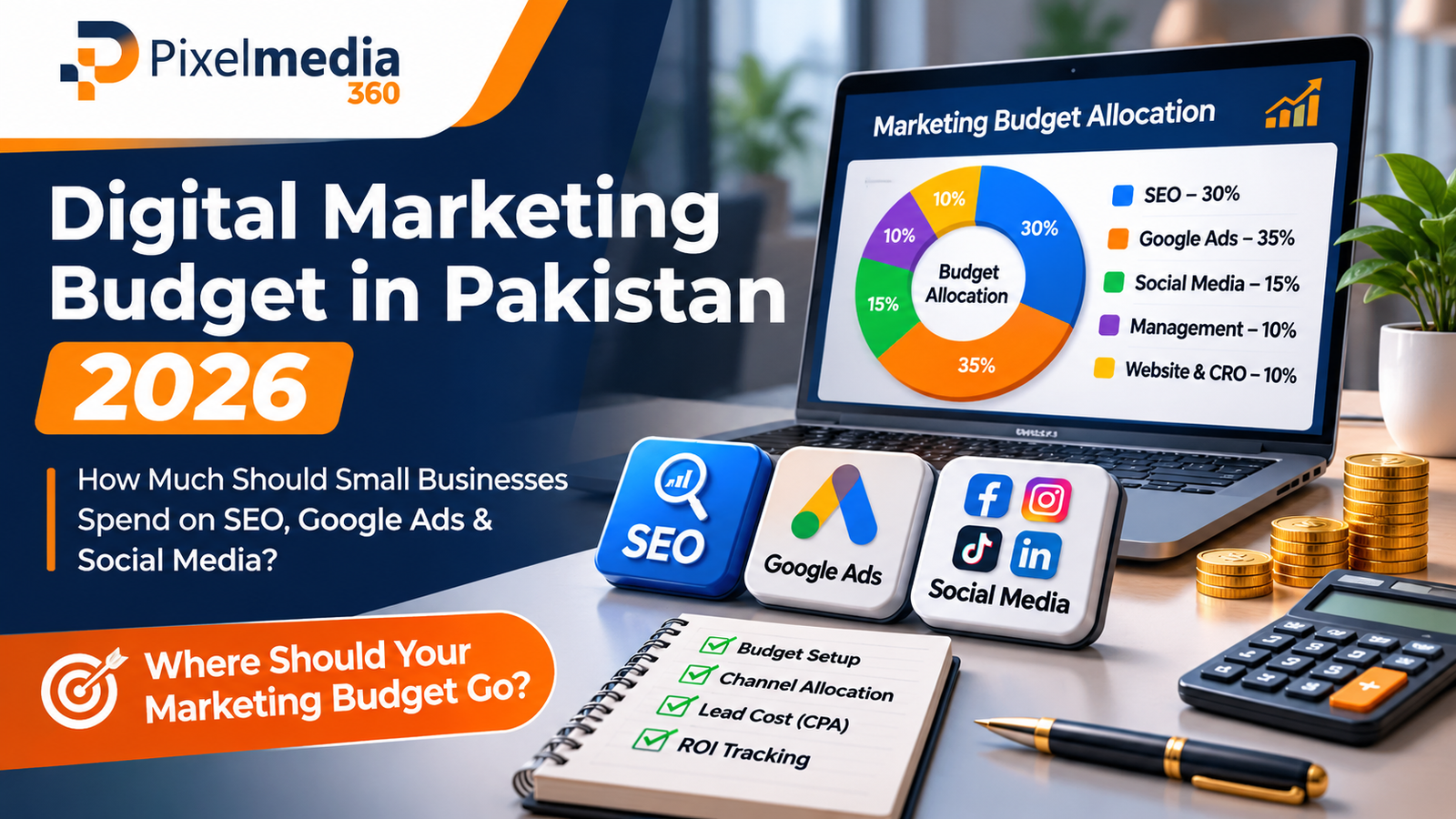
Example: A PKR 100,000 Monthly Marketing Budget
| Activity | Illustrative Allocation | Amount |
| SEO and content improvements | 30% | PKR 30,000 |
| Google Ads media spend | 35% | PKR 35,000 |
| Social media content | 15% | PKR 15,000 |
| Campaign management and reporting | 10% | PKR 10,000 |
| Website and conversion improvements | 10% | PKR 10,000 |
| Total | 100% | PKR 100,000 |
This is a hypothetical budgeting example, not a recommended market rate or Pixel Media 360 service quotation.
Actual provider fees may make this allocation impractical for some businesses. In that case, concentrate resources on fewer channels rather than underfunding every activity.
Should Small Businesses Invest in Every Channel?
Not necessarily.
A new local service company may initially prioritize its website, Google Business Profile, and search advertising.
An established e-commerce business may focus more on paid social campaigns, product content, and customer retention.
The strongest allocation reflects customer behavior and measurable business performance.
1. How Much Should Businesses Allocate to SEO?
SEO focuses on improving organic search visibility and helping customers discover relevant information.
Typical SEO activities include keyword research, technical optimization, service-page improvements, content development, and internal linking.
For example, a company in Islamabad offering accounting services may need pages targeting bookkeeping, payroll, tax, and related commercial searches.
What Influences an SEO Budget?
Website size, technical condition, competition, content requirements, and geographic targets affect the workload.
A small website requiring basic improvements involves different resources from a large e-commerce store with thousands of products.
Before spending, identify the most important pages and their current performance.
Businesses can explore professional SEO services to understand how technical and content optimization support organic visibility.
For a detailed cost discussion, read our SEO pricing guide for businesses in Pakistan.
2. How Much Should Businesses Allocate to Google Ads?
Google Ads allows businesses to purchase advertising placements for relevant audiences and searches.
For businesses targeting customers with immediate purchasing intent, search campaigns may be worth testing.
However, budgets should be based on estimated cost per click, expected conversion rates, and customer value.
Example: Estimating Google Ads Leads
Suppose a business has:
- Monthly advertising spend: PKR 60,000
- Average cost per click: PKR 150
- Landing-page lead conversion rate: 5%
The calculations would be:
First, divide PKR 60,000 by PKR 150 to get 400 estimated clicks.
Next, a 5% conversion rate could generate 20 leads.
Finally, the estimated cost per lead is PKR 3,000.
These figures are hypothetical and exclude management fees.
Important Google Ads Budget Rule
Google Ads generally uses average daily budgets for campaigns.
For most campaigns, the monthly spending limit is calculated using the daily budget multiplied by 30.4.
Daily spending can vary, so businesses should also review account-level billing and budget settings.
Learn more about how Google Ads campaign management can connect targeting, landing pages, and performance measurement.
For more detail, see our Google Ads cost guide for Pakistan.
3. How Much Should Businesses Allocate to Social Media Marketing?
Social media spending can include organic content management and paid advertisements.
These are different costs.
Organic activities may involve content planning, graphics, video editing, captions, and publishing.
Paid campaigns require a separate advertising budget.
Which Businesses Benefit Most?
An online fashion store may prioritize product photographs, Reels, and relevant paid social campaigns.
A professional service company may use educational posts and client-focused information.
A restaurant may create content showing food, facilities, and menu updates.
The correct allocation depends on audience relevance rather than platform popularity.
Businesses should avoid spending their entire budget on visually attractive content without measuring business outcomes.
A structured social media marketing plan helps connect publishing and advertising with customer needs.
4. Why Content Marketing Needs Its Own Budget
Content marketing supports customer education and organic discovery.
Businesses may require blog articles, service-page copy, comparison guides, newsletters, and educational resources.
Useful content can answer questions before customers contact a company.
For example, an article comparing WordPress and Shopify may help customers understand which platform suits their business.
Content production should include research, editing, fact-checking, and relevant on-page SEO.
Avoid allocating the budget solely by article count.
A smaller number of useful articles may provide more value than large volumes of repetitive content.
5. Do Small Businesses Need a Website Optimization Budget?
Yes, when the website has identifiable problems that affect customers.
Even well-targeted marketing cannot compensate for every website issue.
Common conversion barriers include:
- Confusing navigation
- Slow mobile performance
- Unclear service information
- Broken enquiry forms
- Weak calls to action
- Inaccurate contact details
Website optimization does not always require a complete redesign.
Often, targeted improvements can address the most important problems.
Read our guide on why website traffic does not always generate leads to understand common conversion barriers.
Digital Marketing Budget Examples for Different Pakistani Businesses
The following examples describe different budgeting priorities, not fixed percentage rules.
| Business Type | First Priority | Supporting Investment |
| Local service company | Website, local SEO and Google Search | Landing pages and conversion tracking |
| E-commerce store | Product pages and relevant advertising | Product videos, SEO and email retention |
| B2B company | Service content and lead capture | Search marketing and professional content |
| Restaurant | Local presence and useful visual content | Location-targeted promotion |
| New startup | Website foundation and audience research | Limited campaign testing |
| Established company | Proven acquisition channels | Conversion optimization and retention |
Example: An Islamabad Service Business
A service business may first improve its Google Business Profile, website information, and contact process.
Next, it can test relevant search campaigns.
Once tracking provides reliable data, the business can decide whether to increase advertising or invest more in organic visibility.
Example: A Lahore E-Commerce Brand
An online retailer may focus on product-page quality, photography, and social advertising.
Later, it can develop category SEO and customer retention campaigns.
The exact budget should reflect product margins and customer acquisition costs.
8 Common Digital Marketing Budget Mistakes
1. Spending Without Defined Goals
Problem: Marketing expenses are approved without measurable objectives.
Impact: Results become difficult to evaluate.
Better Approach: Define customer acquisition, enquiry, or revenue goals before choosing channels.
2. Choosing Channels Based on Popularity
Problem: Businesses invest in platforms simply because competitors use them.
Impact: Spending may reach irrelevant audiences.
Better Approach: Research where potential customers discover and evaluate services.
3. Ignoring Landing-Page Quality
Problem: Advertising sends visitors to poorly optimized pages.
Impact: Relevant clicks may fail to generate enquiries.
Better Approach: Test the website before increasing traffic spending.
4. Confusing Advertising Spend With Agency Fees
Problem: Businesses assume a management package includes paid media costs.
Impact: Actual monthly expenditure exceeds expectations.
Better Approach: Request separate amounts for media, management, production, and software.
5. Measuring Clicks Instead of Customers
Problem: Campaigns are evaluated through traffic volume alone.
Impact: Low-quality acquisition may appear successful.
Better Approach: Monitor qualified leads and customer acquisition costs.
6. Spreading the Budget Too Thinly
Problem: A limited budget is divided among too many channels.
Impact: Campaigns may lack enough resources for meaningful execution.
Better Approach: Prioritize one or two relevant channels before expanding.
7. Ignoring Existing Customers
Problem: Businesses spend almost everything on acquiring new customers.
Impact: Retention and repeat-purchase opportunities receive little attention.
Better Approach: Evaluate email marketing, customer communication, and appropriate remarketing.
8. Changing Budgets Without Reviewing Data
Problem: Spending is increased or reduced based on short-term fluctuations.
Impact: Businesses may interrupt useful campaigns or repeat ineffective spending.
Better Approach: Review reliable performance data and account for sales cycles.
How to Measure Digital Marketing ROI in Pakistan
Return on investment measures financial results relative to the investment made.
A simplified formula is:
ROI = (Attributable Profit − Marketing Investment) ÷ Marketing Investment × 100
For example, if a business generates PKR 150,000 in attributable contribution after non-marketing delivery costs and spends PKR 50,000 on marketing, the simplified ROI is:
(150,000 − 50,000) ÷ 50,000 × 100 = 200%
This example assumes the revenue attribution and contribution calculations are accurate.
What Should Businesses Track?
Useful metrics include qualified leads, sales conversion rate, customer acquisition cost, attributable revenue, and marketing expenses.
Google Analytics 4 can measure relevant customer actions through configured events and key events.
However, a button click should not automatically count as a successful enquiry.
Businesses should verify conversions and connect marketing data with actual sales outcomes.
A Practical 90-Day Digital Marketing Budget Plan
Days 1–30: Audit and Prepare
Review website performance, audience needs, existing marketing channels, and conversion tracking.
Identify the most commercially relevant opportunities.
Days 31–60: Launch Focused Campaigns
Implement priority SEO improvements and test selected advertising campaigns.
Develop useful supporting content.
Avoid expanding to too many platforms simultaneously.
Days 61–90: Evaluate and Reallocate
Compare spending against qualified leads and customer acquisition.
Improve weak landing pages and adjust marketing priorities based on available evidence.
This plan provides an implementation structure. It does not guarantee improved rankings, leads, or revenue within 90 days.
How to Choose a Digital Marketing Agency in Pakistan
Businesses should compare agencies based on their ability to connect marketing activities with clear objectives.
Review actual capabilities, relevant experience, reporting methods, and project scope.
An agency should explain which services are necessary and which can be introduced later.
Questions to Ask Before Hiring
- Which channels match our customers?
- What is included in the monthly fee?
- Is advertising spend separate?
- How will conversions be measured?
- Who owns the advertising accounts and website assets?
- What reports will we receive?
- How will budget adjustments be decided?
Avoid providers promising guaranteed rankings or fixed sales results without evaluating your business.
How Pixel Media 360 Helps Businesses Plan Digital Marketing Budgets
At Pixel Media 360, we help businesses connect digital marketing activities with practical objectives.
Our services cover:
- Search Engine Optimization
- Google Ads and PPC
- Social Media Marketing
- Content Marketing
- Website Development
- Creative Brand Identity
- Video Production
A business with limited organic visibility may need to prioritize technical SEO and relevant service content.
Another company receiving traffic but limited enquiries may benefit from website conversion improvements.
An e-commerce brand may need to balance advertising, product content, and customer retention.
The correct allocation depends on the business rather than a universal marketing package.
Businesses can review our digital marketing services to understand the different capabilities available.
Frequently Asked Questions
1. What is a digital marketing budget?
A digital marketing budget is the amount a business allocates to online advertising, SEO, content, social media, websites, and performance measurement during a defined period.
2. How much should a small business spend on digital marketing in Pakistan?
There is no fixed amount suitable for every small business. Spending should reflect customer value, business goals, competition, available resources, and the cost of generating qualified enquiries.
3. Is SEO cheaper than Google Ads?
SEO and Google Ads have different cost structures. SEO requires ongoing optimization resources, while Google Ads involves paid media expenditure and potentially management fees.
4. Should Pakistani businesses invest in Google Ads or Facebook Ads?
The better platform depends on customer intent and the offer. Google Search Ads may suit active demand, while Facebook and Instagram advertising can support discovery and relevant audience targeting.
5. How can I calculate digital marketing ROI?
Compare attributable profit against total marketing investment. Include relevant advertising, agency, software, and creative costs where appropriate.
6. Is social media marketing enough for small businesses?
It may support some businesses, but others require organic search visibility, a conversion-focused website, and additional customer acquisition channels.
7. Does Google Ads have a minimum monthly budget?
Businesses can generally choose their own campaign budgets, subject to applicable campaign and platform requirements. However, very small budgets may limit useful traffic and campaign learning.
8. Should website development be included in the marketing budget?
Yes, when the website requires improvements that support customer acquisition. Businesses should separate major one-time development costs from recurring marketing expenses.
9. How often should businesses review marketing spending?
A monthly review can help businesses monitor expenditure and outcomes. More frequent checks may be appropriate for active advertising campaigns.
10. Can Pixel Media 360 help with digital marketing budget planning?
Pixel Media 360 offers SEO, Google Ads, social media marketing, website development, and related services that can support coordinated marketing planning and execution.
Final Thoughts
Planning a digital marketing budget in Pakistan in 2026 requires more than selecting a monthly spending amount.
Businesses need to understand customer behavior, channel costs, website requirements, and the financial value of acquiring customers.
SEO, Google Ads, social media, and content marketing can each support different stages of business growth.
However, the most effective allocation depends on measurable results.
Start with essential marketing foundations, invest in channels that match customer needs, and review acquisition performance before expanding.
A successful marketing budget is not necessarily the largest one. It is the one allocated according to business priorities and reliable performance data.