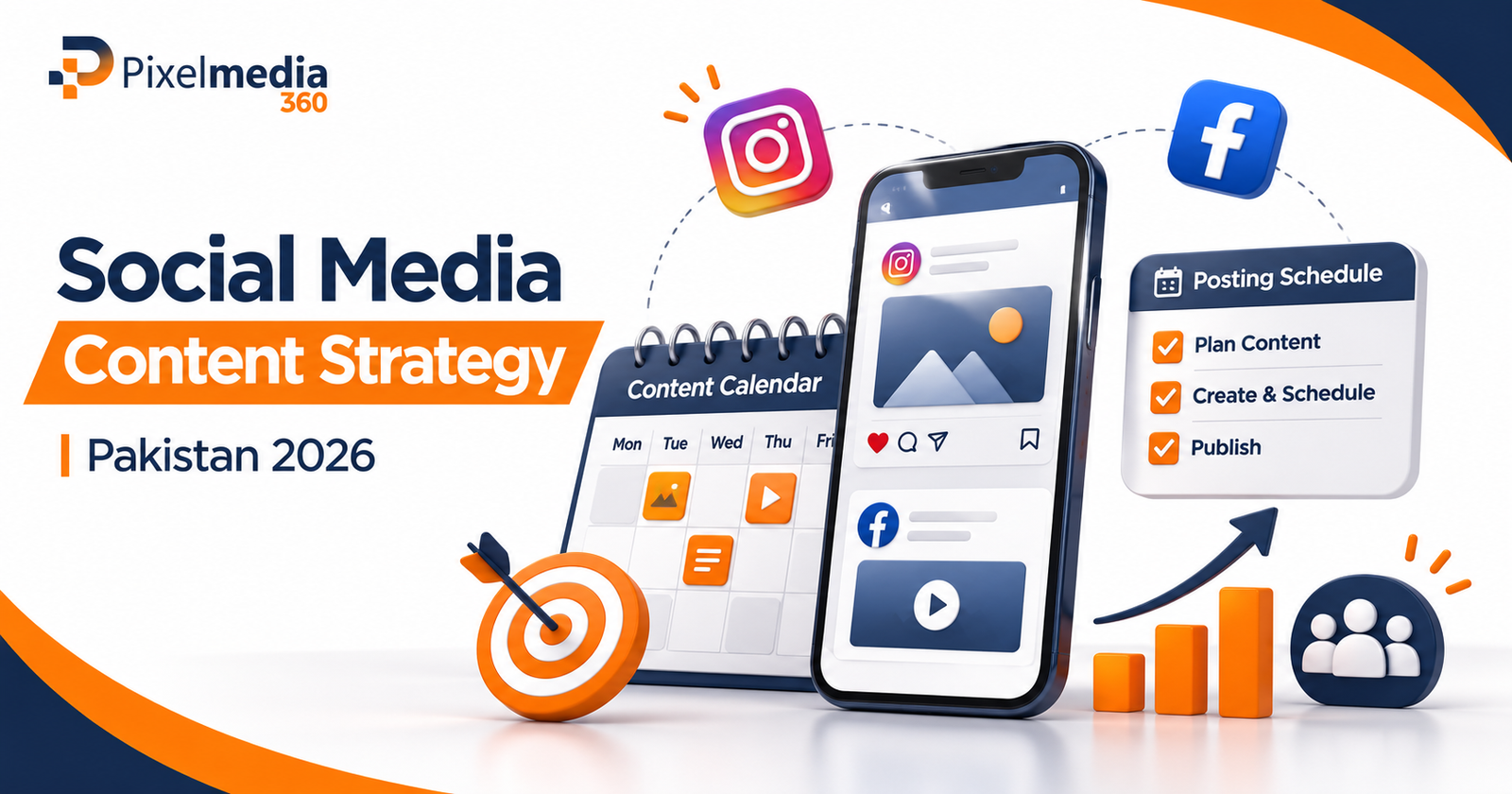
Posting on social media every day does not guarantee that your business will reach the right customers. You might publish attractive Instagram graphics, create Facebook Reels, and share promotional offers, yet still struggle to generate enquiries or sales.
For many Pakistani businesses, the missing element is a clear social media content strategy.
In 2026, customers expect brands to publish useful information, demonstrate products, answer questions, and communicate consistently across digital platforms.
Businesses in Islamabad, Rawalpindi, Lahore, Karachi, and other Pakistani cities need to understand what their audiences want before deciding what to publish.
A structured approach to social media marketing services in Pakistan can connect content creation with brand visibility, customer engagement, and measurable business objectives.
This guide explains what to post, when to post, how often to publish, and how to build a practical social media content calendar for your business.
How Do You Create a Social Media Content Strategy in Pakistan?
A social media content strategy in Pakistan starts with audience research, clear business goals, relevant content pillars, and a consistent posting schedule. Businesses should combine educational posts, short-form videos, product demonstrations, and trust-building content. Posting times should be tested using audience analytics, while success should be measured through engagement, qualified enquiries, and sales rather than likes alone.
What Is a Social Media Content Strategy?
A social media content strategy is a structured plan that defines what a business publishes, who the content is intended for, which platforms it uses, and how results will be measured.
Instead of posting randomly, businesses organize content around audience interests and specific marketing objectives.
A successful strategy typically includes:
- Target audience research
- Brand positioning and messaging
- Content pillars
- Platform selection
- Content formats
- Publishing schedule
- Community engagement
- Performance monitoring
For example, an online clothing store may publish styling tips, product demonstrations, customer questions, and collection announcements.
A professional service provider may focus on educational explanations, industry insights, process demonstrations, and verified client experiences.
Both businesses need content strategies, but their topics and customer journeys will differ.
How Does a Social Media Content Strategy Work?
The process begins by identifying the audience and the problems the business solves.
Next, the company organizes relevant subjects into content categories and selects appropriate platforms.
A publishing calendar then schedules posts, videos, stories, and promotional campaigns.
Finally, the business evaluates performance and adjusts its approach based on meaningful customer actions.
Who Needs a Social Media Content Strategy?
A structured content strategy is useful for:
- Startups
- Small and medium-sized businesses
- E-commerce stores
- Restaurants and retail shops
- Real estate companies
- Professional service providers
- B2B companies
- Established consumer brands
The objective is not simply to publish more content. It is to publish content that supports the right business goals.
Why Social Media Content Planning Matters in Pakistan in 2026
Pakistan has a substantial social media audience.
According to DataReportal’s Digital 2026 report, the country had approximately 79.9 million social media user identities in October 2025.
Facebook’s potential advertising audience was approximately 52.9 million, while Instagram’s was approximately 22.4 million.
These estimates demonstrate the scale of digital opportunities, although they are not equivalent to verified unique active users.
For Pakistani businesses, content planning matters because customers have multiple options when researching products and services.
Competition for Customer Attention
Businesses publishing similar promotional posts may struggle to distinguish themselves.
A clear content strategy allows brands to communicate their expertise, product advantages, and customer value consistently.
Customer Research Before Purchasing
Potential customers often examine a business’s profile, previous posts, product information, and customer feedback before making an enquiry.
Useful content can answer questions and reduce uncertainty.
Local Search and Discovery
Businesses can develop content around relevant customer needs in their service areas.
For example, a home renovation company in Rawalpindi might publish practical renovation advice based on common local requirements.
A digital marketing agency in Islamabad might explain how local businesses can improve their online visibility.
Location references should remain natural and relevant rather than appearing repeatedly in every caption.
What Should Businesses Post on Social Media in 2026?
The right content mix depends on your industry, audience, and marketing objectives.
However, most businesses can organize their content around several useful categories.
1. Educational Content
Educational content answers questions or helps customers understand a subject.
Examples include:
- Common mistakes customers should avoid
- Product usage tutorials
- Industry explanations
- Practical tips
- Step-by-step guides
For example, a digital marketing company could publish a carousel titled:
“5 Reasons Your Website Is Not Generating Enquiries.”
Educational content helps businesses demonstrate useful knowledge without making every post promotional.
2. Product and Service Content
Customers need clear information about what a business offers.
Product and service content can include demonstrations, specifications, availability, features, and explanations.
For example, an e-commerce clothing brand could publish a Reel showing the fabric, fit, and appearance of a product.
A web development company might explain the differences between WordPress and Shopify.
The goal is to support informed purchasing decisions.
3. Trust-Building Content
Trust-building content helps customers evaluate a company’s credibility.
Suitable examples include:
- Genuine customer testimonials
- Verified project examples
- Behind-the-scenes videos
- Team introductions
- Business processes
- Real product photographs
Avoid fabricated reviews, exaggerated results, or misleading before-and-after comparisons.
4. Short-Form Video Content
Instagram Reels, Facebook Reels, TikTok videos, and YouTube Shorts can communicate information through short visual formats.
Useful video subjects include:
- Product demonstrations
- Frequently asked questions
- Quick tutorials
- Service explanations
- Industry insights
- Behind-the-scenes processes
A strong video should communicate its subject early, provide relevant information, and remain understandable with captions where appropriate.
Businesses requiring professional video assets can explore Pixel Media 360’s production services.
5. Engagement and Community Content
Community content encourages relevant audience participation.
Examples include polls, question stickers, feedback requests, and useful discussions.
For instance, a skincare brand might ask customers which product information they find most difficult to understand.
The responses can inform future educational content.
Engagement should be genuine rather than based on artificial requests for likes or comments.
6. Promotional and Conversion-Focused Content
Promotional posts explain relevant offers and guide potential customers toward an appropriate action.
Examples include:
- New collection announcements
- Product launches
- Service availability
- Seasonal campaigns
- Consultation invitations
- Special offers with accurate conditions
Promotional content should clearly explain what customers receive and what they need to do next.
How to Build a Social Media Content Strategy: 7 Practical Steps
Step 1: Define Your Business Objectives
Start with a measurable goal.
Your primary objective might be to increase relevant enquiries, improve brand recognition, generate online purchases, or develop stronger customer relationships.
Avoid treating follower growth as the only measure of success.
Step 2: Research Your Target Audience
Identify your customers’ needs, concerns, locations, preferred platforms, and purchasing behavior.
Use customer questions, sales feedback, social platform insights, and relevant competitor research.
For example, a business selling professional accounting services will likely require different content from a fashion retailer.
Step 3: Select the Right Social Media Platforms
Choose channels based on audience relevance.
Instagram can support visually oriented brands and product discovery.
Facebook can support community communication, varied content formats, and advertising.
LinkedIn is useful for professional and B2B communication.
YouTube can support tutorials, demonstrations, and longer educational content.
A business does not need to publish on every platform to develop an effective strategy.
Step 4: Create Content Pillars
Content pillars are recurring categories that keep publishing focused.
A service business might use four pillars:
- Education
- Service information
- Trust and credibility
- Customer engagement
Each pillar should connect with a genuine audience need or business objective.
Step 5: Develop a Content Calendar
Create a monthly calendar that identifies the publishing date, platform, format, topic, objective, and responsible team member.
A content calendar can reduce last-minute production and improve consistency.
However, it should remain flexible enough to accommodate relevant business updates.
Step 6: Produce Platform-Appropriate Content
A single topic can be adapted to different platforms.
For example, a website optimization guide might become an Instagram carousel, a short Facebook video, and a LinkedIn explanation.
Adapt the presentation instead of publishing identical content everywhere without considering the platform.
Step 7: Measure Results and Refine Your Strategy
Monitor performance regularly.
Identify which topics generate relevant engagement, website visits, and business enquiries.
Use the findings to improve future content rather than repeating the same schedule indefinitely.
Sample Weekly Social Media Content Calendar for Pakistani Businesses
The following calendar is an illustrative starting point for a small service-based business.
| Day | Content Type | Example Topic | Primary Goal |
| Monday | Educational Carousel | 5 Common Customer Mistakes | Awareness |
| Tuesday | Instagram Reel | Quick Service Tip | Discovery |
| Wednesday | Trust-Building Post | Genuine Project Example | Credibility |
| Thursday | Educational Video | How Our Service Works | Consideration |
| Friday | Promotional Post | Service Consultation | Enquiries |
| Saturday | Interactive Story | Customer Questions | Engagement |
| Sunday | Review and Planning | Analyze Weekly Performance | Optimization |
This is not a mandatory seven-day publishing schedule.
Businesses with limited resources can start with three or four high-quality weekly posts and expand only when the content process is sustainable.
Example Content Mix for a Month
A hypothetical 20-post monthly plan could include:
- 7 educational posts
- 5 product or service posts
- 4 trust-building posts
- 2 engagement posts
- 2 promotional posts
This distribution is a planning example, not a scientifically established posting ratio.
Adjust the balance according to what your customers find useful and what supports meaningful business results.
Best Time to Post on Social Media in Pakistan in 2026
There is no universal posting time that guarantees higher reach or engagement.
The right time depends on the platform, industry, audience habits, content format, and day of the week.
However, some Pakistan-focused marketing guides identify evening activity as a useful starting point for testing.
Suggested Posting Times to Test in Pakistan
| Platform | Initial Time Windows (PKT) |
| 1 PM–3 PM and 8 PM–11 PM | |
| 1 PM–3 PM and 8 PM–10 PM | |
| TikTok | 7 PM–11 PM |
| Test business hours on weekdays | |
| YouTube | Schedule around audience viewing patterns |
These are experimental starting windows, not verified universal optimum times. Performance varies by audience and account.
How to Find Your Own Best Posting Time
Check Instagram’s Professional Dashboard to find out when your followers are most active.
Use Meta Business Suite to analyze your Facebook audience and post performance.
Review YouTube Studio analytics to identify when your viewers are online.
Test different time slots for several weeks while keeping other variables reasonably consistent.
Compare reach, watch time, engagement, clicks, and relevant conversions.
Posting when followers are active may improve opportunities for interaction, but timing alone cannot compensate for weak or irrelevant content.
How Often Should Businesses Post on Social Media?
Many businesses assume that publishing more frequently always creates better results.
In reality, there is no universal posting frequency that guarantees growth.
A practical approach is to choose a schedule that balances content quality, production capacity, and audience demand.
For example:
Small local business: Three or four carefully planned posts per week may be manageable.
Growing e-commerce brand: A combination of product content, short-form videos, and Stories may be appropriate.
B2B service company: A smaller number of detailed professional insights may be more valuable than frequent generic updates.
Evaluate posting frequency through actual performance rather than copying competitors blindly.
Consistency helps maintain an organized content process, but content quality and customer relevance remain central.
Social Media Content Strategy Costs in Pakistan in 2026
Social media content planning costs vary according to the number of platforms, production requirements, posting frequency, and management services.
Publicly advertised packages from Pakistani providers show a wide range of prices.
Indicative Monthly Social Media Management Costs
| Service Scope | Estimated Monthly Cost |
| Basic content and scheduling | PKR 15,000–35,000 |
| Content design and management | PKR 35,000–65,000 |
| Strategy-led multi-platform management | PKR 65,000–120,000 |
| Advanced content and video production | PKR 120,000–300,000+ |
These are illustrative ranges drawn from publicly advertised Pakistan-market pricing in 2026, not official Pixel Media 360 rates or statistically representative market averages.
What Affects the Cost?
Number of platforms: Managing multiple channels requires additional planning, adaptation, and reporting.
Content volume: More posts and videos generally increase production requirements.
Creative complexity: Custom animation, professional photography, and video shoots may involve additional costs.
Community management: Responding to messages and comments requires ongoing resources.
Advertising management: Paid campaign setup and optimization may carry separate fees.
Reporting: Advanced performance tracking and strategic analysis can affect package pricing.
Advertising spend is normally separate from organic content management fees.
Businesses should compare written deliverables rather than choosing solely on monthly price.
Organic Content vs Paid Social Media Advertising
Organic and paid social media activities support different stages of business development.
| Feature | Organic Social Media | Paid Social Advertising |
| Distribution | Unpaid platform distribution | Purchased placements |
| Main Purpose | Ongoing communication and audience development | Specific campaign objectives |
| Media Spend | No direct payment for each organic post | Advertising budget required |
| Audience Targeting | Influenced by platform recommendation systems | Campaign targeting options |
| Conversion Opportunities | Depends on audience and content | Depends on targeting, offer and conversion setup |
| Measurement | Reach, engagement, referrals and enquiries | Clicks, conversions, CPA and ROAS |
Which Approach Is Better for Pakistani Businesses?
Neither approach is universally superior.
Organic content can help customers understand and evaluate a brand.
Paid campaigns can reach additional relevant audiences and support defined advertising objectives.
For example, an e-commerce business may publish product demonstrations organically and then test selected content through Meta advertising.
The right balance depends on available resources and business goals.
Pixel Media 360’s Instagram advertising services can complement a broader organic content strategy.
7 Common Social Media Content Planning Mistakes
1. Posting Without Understanding Your Audience
Problem: Content is created without researching customer interests.
Impact: Posts may attract irrelevant engagement or receive little response.
Better Approach: Use customer questions and audience insights to select useful topics.
2. Publishing Promotional Content Only
Problem: Every post directly asks customers to buy.
Impact: Followers may receive little educational or practical value.
Better Approach: Balance commercial messaging with informative and trust-building content.
3. Copying Every Trending Reel
Problem: Businesses follow viral trends without considering brand relevance.
Impact: Posts may attract attention without communicating useful business information.
Better Approach: Participate only in trends that genuinely fit the brand and its customers.
4. Ignoring Content Quality
Problem: Posts use unclear graphics, inaccurate claims, or repetitive messages.
Impact: Customers may struggle to understand the content or trust the brand.
Better Approach: Prioritize accuracy, readability, original creative work, and useful information.
5. Posting at Random Times Without Testing
Problem: Publishing schedules are based entirely on assumptions.
Impact: Businesses miss opportunities to understand audience activity.
Better Approach: Test different publishing windows and review account-specific analytics.
6. Using Weak Calls to Action
Problem: Posts do not explain the intended next step.
Impact: Interested customers may leave without making an enquiry.
Better Approach: Use a clear action aligned with the content, such as viewing a product, exploring a service, or requesting a quotation.
7. Measuring Likes Instead of Business Outcomes
Problem: Social media performance is evaluated only through reactions or followers.
Impact: Popular content may be mistaken for commercially effective content.
Better Approach: Track relevant engagement, website visits, qualified leads, and sales.
Benefits of a Well-Planned Social Media Content Strategy
Stronger Brand Recognition
Consistent visual identity and messaging help customers recognize a business across different platforms.
Better Audience Engagement
Relevant content can encourage genuine interaction and ongoing customer relationships.
More Efficient Content Production
Planning in advance helps businesses coordinate topics, creative assets, publishing schedules, and approvals.
Improved Customer Trust
Useful explanations, accurate business information, and genuine examples can help potential customers evaluate products and services.
More Qualified Enquiry Opportunities
Content designed around customer needs can support enquiries when paired with clear offers and effective conversion paths.
Measurable Marketing Improvements
Regular analysis makes it easier to understand which content contributes to business objectives.
How to Choose a Social Media Marketing Agency in Pakistan
Choosing an agency requires evaluating its ability to connect creative production with business goals.
Review the Agency’s Content Quality
Examine real examples of social media posts, videos, campaigns, and brand communication.
Understand Its Planning Process
A suitable agency should conduct audience research and establish clear content objectives.
Evaluate Platform Experience
Confirm that the team understands the platforms relevant to your business.
Check Reporting Practices
Look for meaningful reporting on reach, engagement, website activity, leads, and campaign results.
Compare Pricing Transparently
Confirm whether content creation, photography, video production, paid advertising management, and community support are included.
Review Relevant Experience
Industry experience and genuine project examples can help you assess whether an agency understands your marketing requirements.
Businesses in Islamabad, Rawalpindi, and other Pakistani cities should prioritize clear communication and realistic objectives over promises of guaranteed viral growth.
How Pixel Media 360 Helps Businesses Build Better Social Media Strategies
At Pixel Media 360, we help businesses develop social media marketing strategies around relevant audiences, consistent branding, and measurable objectives.
Our services include:
- Social Media Marketing
- Content Marketing
- Instagram Ads
- Facebook Ads
- LinkedIn Ads
- YouTube Ads
- Video Production
- Copywriting
- Creative Brand Identity
Our approach combines content research, campaign planning, visual production, publishing, and performance monitoring.
Whether your business needs a structured monthly content calendar, professional creative assets, or paid social advertising, the strategy should reflect your customers and commercial objectives.
Explore Pixel Media 360’s social media marketing services to understand our approach.
Frequently Asked Questions
1. What is a social media content strategy?
A social media content strategy is a structured plan covering audience research, content topics, platform selection, publishing schedules, and performance measurement to support business objectives.
2. What should small businesses post on social media in Pakistan?
Small businesses can publish educational tips, service explanations, product demonstrations, genuine customer experiences, short videos, and relevant promotional content.
3. What is the best time to post on Instagram in Pakistan?
There is no universally best time. Afternoon and evening periods can be useful starting points for testing, but businesses should use their Instagram insights to identify audience-specific patterns.
4. How many posts should a business publish per week?
The right frequency varies. A small business may begin with three or four quality posts weekly and adjust based on audience response and production capacity.
5. Are Instagram Reels better than static posts?
Reels and static posts serve different purposes. Reels can support video discovery, while carousels and graphics can explain detailed information. Both should be evaluated through performance data.
6. How much does social media management cost in Pakistan?
Published package prices vary widely. Basic management can start around PKR 15,000–35,000 monthly, while comprehensive strategy and production packages may exceed PKR 100,000.
7. Can social media content generate leads without paid ads?
Yes. Useful organic content and clear enquiry paths can generate leads, but results depend on audience relevance, distribution, offer quality, and customer trust.
8. Which social media platform is best for businesses in Pakistan?
The most suitable platform depends on the audience and business model. Instagram may suit visual brands, Facebook may support community engagement, and LinkedIn may be useful for B2B companies.
9. How long does a social media content strategy take to show results?
There is no guaranteed timeline. Businesses can measure initial performance soon after publishing, while sustained audience development and reliable lead generation may require ongoing testing.
10. Does Pixel Media 360 provide social media content planning services?
Pixel Media 360 offers social media marketing services, including content strategy, creative development, campaign planning, and performance analysis.
Final Thoughts
An effective social media content strategy in Pakistan in 2026 requires more than publishing attractive posts at popular times.
Businesses need to understand their customers, develop useful content, maintain a practical publishing schedule, and measure meaningful outcomes.
The right content strategy connects audience needs with clear business objectives.
Instead of asking how often you should post, begin by identifying what your customers need to know and how your content can help them make informed decisions.
Build a Social Media Strategy That Supports Business Growth
Pixel Media 360 helps businesses develop content strategies, creative campaigns, and targeted social media marketing solutions.