Every business wants customers to recognize its name, remember its products, and trust its services. However, many companies invest in a logo without developing the visual identity and brand messaging needed to create a consistent impression.
A professional logo is important, but it represents only one part of your business identity.
In Pakistan’s competitive business environment, brand identity design helps companies establish recognizable visuals, communicate their values, and create consistent experiences across websites, packaging, social media, and advertising.
Businesses in Islamabad, Rawalpindi, Lahore, Karachi, and other Pakistani cities need branding that reflects their target audience and business positioning.
Professional creative brand identity services can help businesses develop coordinated design systems rather than relying on disconnected graphics.
This guide explains the difference between logo design and brand identity, the essential elements of branding, the design process, common mistakes, costs in Pakistan, and how to choose a suitable branding agency in 2026.
Quick Answer: What Is Brand Identity Design in Pakistan?
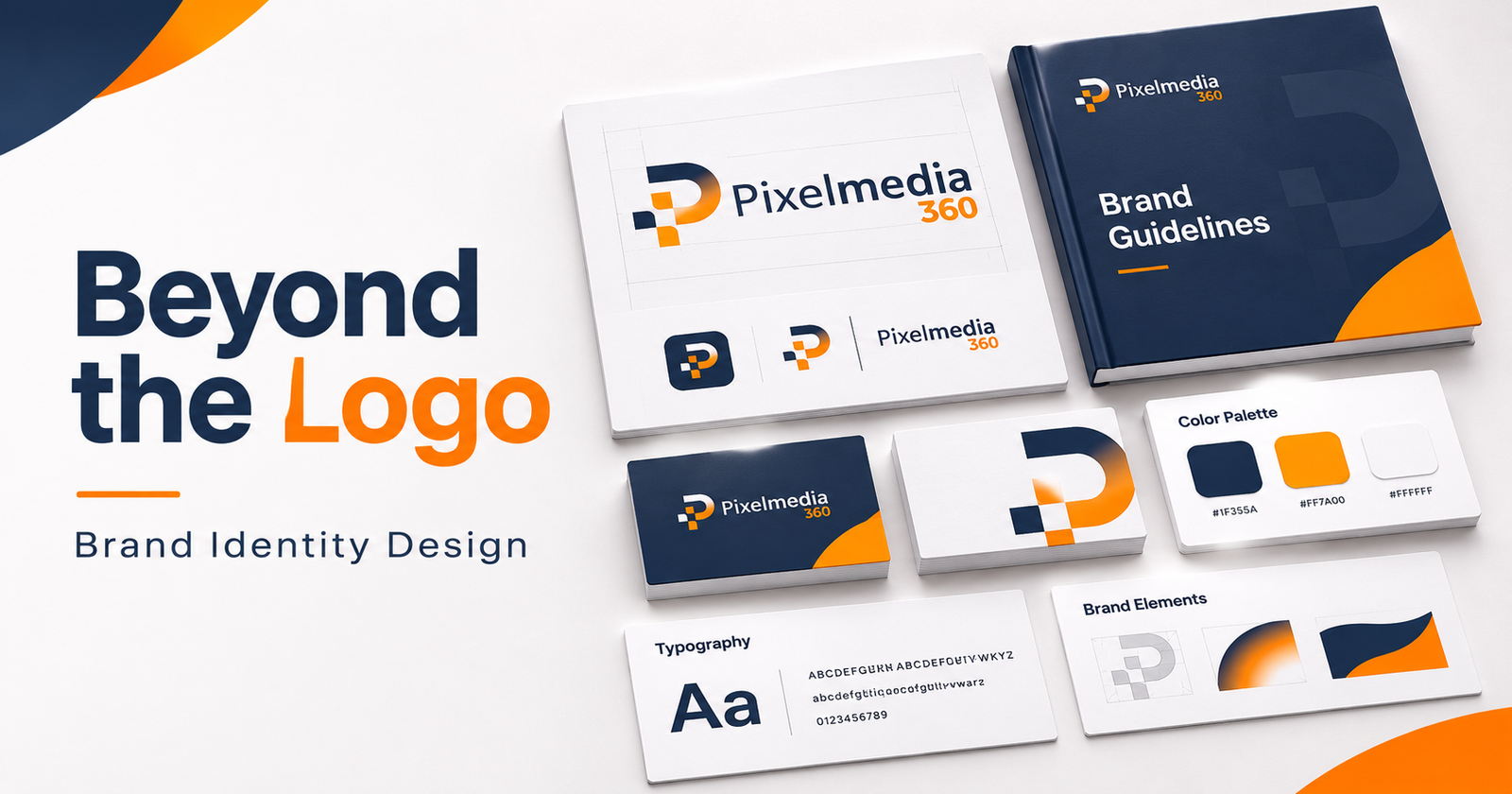
Brand identity design in Pakistan is the process of creating a consistent visual and communication system for a business. It includes logo design, brand colors, typography, imagery, messaging, and brand guidelines. While a logo helps customers recognize a company, a complete brand identity helps businesses communicate consistently across websites, social media, packaging, and marketing materials.
What Is Brand Identity Design?
Brand identity design is the development of visual and communication elements that represent a business.
It defines how a brand presents itself to customers across different platforms and physical environments.
A complete identity may include:
- Primary and secondary logos
- Brand color palettes
- Typography systems
- Visual design elements
- Photography and illustration styles
- Brand messaging and tone of voice
- Social media design templates
- Business stationery
- Packaging and signage
- Brand usage guidelines
These elements work together to give a business a recognizable appearance.
For example, a clothing company might use a specific color palette, photography style, typography system, and packaging design.
When customers visit its website, Instagram profile, or physical store, they should encounter a consistent brand presentation.
Why Is Brand Identity Important?
Brand identity gives businesses a practical framework for communicating visually.
Without it, designers, marketers, and employees may produce materials that look unrelated.
A consistent identity makes it easier to maintain recognizable branding as a company introduces new products, advertising campaigns, and marketing channels.
However, branding should also reflect business quality and customer experience. Attractive design alone cannot compensate for unreliable products or poor service.
Brand Identity vs Logo Design: What’s the Difference?
Many Pakistani business owners use the terms logo design and branding interchangeably.
However, they describe different areas of work.
A logo is a recognizable visual symbol or wordmark representing a company.
A brand identity is the broader system that determines how the company looks and communicates.
Logo Design vs Brand Identity Comparison
| Feature | Logo Design | Brand Identity Design |
| Main Purpose | Identify a business | Create consistent brand presentation |
| Scope | Symbol, wordmark, logo variations | Logo, colors, typography, imagery, messaging and guidelines |
| Deliverables | Logo files and variations | Complete visual identity system |
| Applications | Website, signage, profiles | All major brand touchpoints |
| Research | Design brief and relevant visual research | Audience, competitors, positioning and brand strategy |
| Best For | Limited design requirements | Businesses requiring consistent branding |
Example: A New Restaurant in Islamabad
Imagine a restaurant launching in Islamabad.
It commissions a logo featuring its business name.
However, the restaurant’s menu uses one font, its packaging uses unrelated colors, and its Instagram graphics follow different styles.
Customers may struggle to connect these materials with the same brand.
A complete brand identity would establish consistent colors, typography, menu layouts, packaging elements, and social media templates.
The restaurant could then use a unified visual style across different customer touchpoints.
A logo identifies your business. Brand identity defines how your business presents itself.
7 Essential Elements of a Professional Brand Identity
1. Brand Strategy and Positioning
Before choosing colors or designing a logo, a business should understand its market position.
Brand strategy answers questions such as:
- Who are our customers?
- What problems do we solve?
- What makes our business different?
- How should customers perceive us?
- What values guide our communication?
For example, a premium furniture retailer may need a different visual style from a budget-focused furniture store.
Both businesses sell furniture, but their audiences and positioning differ.
Clear positioning helps guide design decisions.
2. Professional Logo Design
A logo is one of the most visible elements of brand identity.
It appears on websites, business cards, social profiles, packaging, invoices, and promotional materials.
An effective logo should be recognizable, appropriate for the intended audience, and practical across different sizes.
Businesses may need:
- Primary logo
- Secondary logo
- Icon or symbol
- Horizontal and vertical versions
- Monochrome variations
- Transparent background files
- Vector files for printing and scaling
A professional designer should also check whether the logo remains clear on small screens and printed materials.
Businesses can explore Pixel Media 360’s logo design services for custom logo development.
3. Brand Color Palette
Colors help establish a consistent visual style.
A brand palette typically includes primary, secondary, and neutral colors.
Each color should have defined values for digital and print applications.
For example, a financial services company may use a restrained color system to support a professional presentation.
A children’s clothing brand may prefer a brighter and more playful palette.
Color choices should reflect the audience, application, and brand positioning.
Avoid assuming that a particular color automatically creates trust or increases sales.
4. Typography and Font Selection
Typography influences how customers read and understand branded content.
Businesses need a consistent approach to headings, body text, labels, and promotional materials.
A typography system should specify:
- Heading fonts
- Body fonts
- Font sizes and hierarchy
- Weight variations
- Spacing rules
- Appropriate digital and print usage
For Pakistani businesses communicating in English and Urdu, font selection should also support the required scripts.
Readable typography is particularly important for mobile websites and social media graphics.
5. Brand Voice and Messaging
Brand identity is not limited to visual design.
Businesses also communicate through website content, advertisements, captions, customer messages, and service descriptions.
A brand voice defines how the company speaks to its audience.
For example, a legal consultancy may use precise and formal language.
A lifestyle brand may communicate through a more conversational style.
The appropriate tone depends on the audience and business objectives.
Consistent messaging helps customers understand what a company stands for.
6. Visual Content and Photography Style
Product photographs, illustrations, icons, and graphic layouts should follow a recognizable visual direction.
For example, an e-commerce clothing brand might use consistent backgrounds, lighting, image framing, and product presentation.
A construction company might prioritize realistic project photography and clear technical illustrations.
A professional visual system reduces inconsistencies across campaigns.
7. Brand Guidelines
Brand guidelines document the rules for using a company’s visual identity.
They help employees, designers, advertising agencies, and printing vendors create consistent materials.
A practical brand guide may include:
- Logo placement and clear space
- Approved logo variations
- Color codes
- Typography hierarchy
- Image treatment
- Social media templates
- Brand voice
- Incorrect logo usage examples
These guidelines become particularly valuable as a business grows and works with multiple creative teams.
How to Create a Brand Identity in Pakistan: Step-by-Step Process
Step 1: Understand Your Business
Start by defining your products, services, customers, and objectives.
Determine how the brand should be positioned within its market.
Step 2: Research Your Competitors
Review businesses targeting similar customers.
Examine their visual identities, messaging, websites, packaging, and marketing materials.
The objective is to understand the competitive environment, not copy another brand.
Step 3: Develop Brand Positioning
Identify the central message your business should communicate.
Clarify the brand’s practical advantages, values, and personality.
Step 4: Create Visual Concepts
Develop logo concepts, typography options, color palettes, and initial visual directions.
Evaluate each option against the brand strategy.
Step 5: Refine the Selected Identity
Review the chosen direction for usability, consistency, and suitability.
Test it across relevant applications such as mobile screens, packaging, stationery, and signage.
Step 6: Develop Brand Guidelines
Document the approved design rules.
Include sufficient detail for future designers and marketing teams.
Step 7: Apply the Identity Across Platforms
Update your website, social media profiles, advertising designs, business materials, and packaging where applicable.
Step 8: Maintain Brand Consistency
Review future creative work against your brand guidelines.
Update the system when business requirements change rather than redesigning everything for each campaign.
8 Common Branding Mistakes Pakistani Businesses Should Avoid
1. Treating a Logo as a Complete Brand
Problem: A business purchases a logo without defining supporting colors, typography, or design rules.
Impact: Marketing materials become inconsistent.
Better Approach: Develop at least a basic brand system covering the essential visual elements.
2. Copying Competitor Branding
Problem: Businesses imitate another company’s logo or visual identity.
Impact: The brand may lack differentiation and could create intellectual property concerns.
Better Approach: Conduct competitor research while developing original concepts appropriate to your business.
3. Using Too Many Fonts and Colors
Problem: Every design uses different visual elements.
Impact: Customers encounter an inconsistent presentation.
Better Approach: Establish a limited, flexible palette and clear typography hierarchy.
4. Ignoring the Target Audience
Problem: Branding decisions depend only on the owner’s personal preferences.
Impact: The identity may not match customer expectations.
Better Approach: Evaluate design choices against audience needs and brand positioning.
5. Choosing Designs That Do Not Scale
Problem: A complex logo looks attractive on a large display but becomes unreadable on mobile screens.
Impact: The design becomes difficult to use across formats.
Better Approach: Test logos and other visual elements at multiple sizes.
6. Not Creating Brand Guidelines
Problem: Designers have no agreed rules for applying the identity.
Impact: Websites, advertisements, and printed materials gradually become inconsistent.
Better Approach: Document logo usage, colors, typography, and common applications.
7. Ignoring Digital Brand Consistency
Problem: The website, Facebook page, Instagram profile, and advertising campaigns use unrelated styles.
Impact: Customers may find it harder to recognize the business.
Better Approach: Coordinate branding across relevant platforms.
A structured social media content strategy can help maintain consistent visual communication.
8. Failing to Secure Final Design Files
Problem: Businesses receive only low-resolution images without editable files or clear usage rights.
Impact: Future redesigns, printing, and marketing production may become difficult.
Better Approach: Agree on source-file delivery, file formats, font licensing, and intellectual property terms before starting the project.
How Much Does Brand Identity Design Cost in Pakistan in 2026?
Brand identity design costs in Pakistan vary significantly based on project scope, designer experience, research requirements, and final deliverables.
A simple logo project costs substantially less than a complete brand identity system.
Indicative Branding Prices in Pakistan
| Branding Service | Indicative Cost (PKR) |
| Basic freelance logo design | 5,000–20,000 |
| Professional logo design | 20,000–60,000 |
| Startup brand identity package | 25,000–75,000 |
| Complete visual identity system | 75,000–200,000 |
| Comprehensive branding and strategy | 200,000–500,000+ |
These ranges are indicative examples based on publicly advertised Pakistani design services and pricing guides in 2026. They are not official market averages or Pixel Media 360 quotations.
What Affects Branding Costs?
Research and strategy: Audience research, competitor analysis, and positioning require additional planning.
Number of deliverables: A logo-only project differs from a full identity package with templates and guidelines.
Design complexity: Custom illustrations, icons, packaging, and extensive creative systems increase production requirements.
Revisions: The number and scope of design revisions influence the project.
Applications: Branding for websites, social media, packaging, stores, and company vehicles involves additional work.
Agency experience: Providers may charge differently based on expertise, process, and deliverables.
How Should Small Businesses Set a Branding Budget?
Start by identifying where customers will encounter the brand.
A new online business may prioritize its logo system, color palette, typography, website graphics, and social media templates.
A physical retail business may also require signage, packaging, printed materials, and storefront graphics.
Compare quotations based on what each provider actually includes.
Businesses should confirm ownership and usage rights, final file formats, and brand guidelines before approving a project.
Brand Identity vs Rebranding: When Do You Need Each?
Brand identity development and rebranding are related but different activities.
| Factor | New Brand Identity | Rebranding |
| Business Stage | New or early-stage business | Existing business |
| Main Objective | Create an initial recognizable identity | Update or change an existing identity |
| Research | Target audience and market positioning | Current brand perception and strategic needs |
| Typical Work | New visual identity and guidelines | Refresh or replacement of existing assets |
| Main Challenge | Establishing consistency from the beginning | Maintaining recognition during change |
When Should a Business Consider Rebranding?
Rebranding may be appropriate when:
- The company changes its market positioning.
- The existing identity no longer reflects its services.
- A merger or major business change requires new branding.
- The visual system cannot support current applications.
- The business expands into substantially different markets.
However, a company should not rebrand merely because its logo looks old.
A visual refresh may be sufficient when the existing brand remains recognizable and relevant.
Benefits of Professional Brand Identity Design
1. Stronger Brand Recognition
Consistent visual elements make it easier for customers to recognize a business across repeated interactions.
2. Clearer Business Positioning
Design and messaging can communicate whether a brand focuses on affordability, specialist expertise, convenience, or a premium experience.
3. Consistent Marketing Materials
A documented identity helps teams produce coordinated websites, advertisements, social posts, and printed materials.
4. More Efficient Creative Production
Approved templates and design rules reduce repeated decisions when producing marketing content.
5. Support for Customer Trust
Professional and consistent presentation can contribute to credibility when accompanied by reliable products, accurate information, and good service.
6. Better Long-Term Brand Management
A flexible identity system can support new campaigns, platforms, and business applications without requiring constant redesign.
How Brand Identity Supports Digital Marketing and SEO
Brand identity and SEO have different functions, but they can support the same business goals.
SEO helps potential customers discover a business through relevant searches.
Brand identity helps communicate a consistent business presentation after customers encounter its website or marketing content.
Website Experience
Consistent colors, typography, and design patterns help create an organized website.
Clear navigation and readable content remain essential.
Social Media Marketing
Brand guidelines help maintain a recognizable appearance across posts, videos, and advertising campaigns.
Paid Advertising
Consistent creative assets can reinforce brand recognition across repeated advertising exposure.
Content Marketing
Brand voice and messaging help maintain a consistent communication style in blogs, service pages, and promotional content.
Local Business Presence
Accurate naming, logos, business information, and relevant images help customers recognize the business across its website and Google Business Profile.
Branding does not directly guarantee higher Google rankings. However, a well-managed identity can support a clearer customer experience.
How to Choose a Branding Agency in Pakistan
Before selecting a branding agency, review its design process and project deliverables.
Evaluate Its Portfolio
Look for genuine work that demonstrates consistent branding across multiple formats.
A logo mockup alone may not show how a complete visual identity performs.
Understand the Research Process
The agency should ask about your business, market, customers, and objectives before developing concepts.
Review Brand Guidelines
Determine whether the final package includes documentation that your team can use.
Confirm File Ownership
Clarify editable source files, licensing, usage rights, and any restrictions.
Compare Written Quotations
Check the number of concepts, revision rounds, applications, final deliverables, and project timeline.
Consider Local Market Understanding
For businesses in Islamabad, Rawalpindi, Lahore, Karachi, and other Pakistani markets, an understanding of local customer needs can improve the relevance of branding decisions.
Choose an agency based on its process, expertise, and deliverables rather than price alone.
Why Choose Pixel Media 360 for Brand Identity Design in Pakistan?
At Pixel Media 360, we help businesses create recognizable brand identities supported by consistent visual communication.
Our creative brand identity services include:
- Professional Logo Design
- Visual Brand Identity
- Brand Guidelines
- Typography and Color Systems
- Creative Art Direction
- Social Media Design
- Advertising Creatives
- Graphic Design
Our branding process focuses on understanding the business, its audience, and the practical applications of the identity.
A startup may need a flexible visual foundation for its website and social media channels.
An established company may require more consistent branding across its advertising materials and customer communications.
Pixel Media 360 also offers social media marketing services to help businesses apply their branding across relevant digital campaigns.
Explore our Creative Brand Identity Services to learn more about our branding and graphic design capabilities.
Frequently Asked Questions
1. What is brand identity design?
Brand identity design involves creating a consistent system of logos, colors, typography, imagery, and messaging that represents a business across different platforms.
2. What is the difference between logo design and brand identity?
A logo is one visual element used to identify a business. Brand identity includes the broader design and communication system that supports consistent presentation.
3. How much does brand identity design cost in Pakistan?
Costs vary by project scope and provider. Basic logo projects may cost a few thousand rupees, while comprehensive identity systems with strategy and guidelines can cost several hundred thousand rupees.
4. Why do small businesses need brand guidelines?
Brand guidelines help small businesses maintain consistent logo usage, colors, typography, and visual layouts as they create new marketing materials.
5. How long does a brand identity project take?
A simple logo project may take several days or weeks. A complete branding project can take longer because it involves research, concept development, revisions, and documentation.
6. Can a business create its own brand identity?
Yes. Small businesses can develop basic visual rules internally. However, businesses requiring extensive applications or specialist design work may benefit from professional support.
7. Does brand identity improve sales?
Brand identity can support recognition, credibility, and consistent communication. Sales outcomes also depend on product quality, pricing, customer experience, marketing, and other factors.
8. What should a complete brand identity package include?
A typical package includes logo variations, color codes, typography, visual rules, relevant templates, and brand guidelines. The exact deliverables depend on the agreed scope.
9. When should a Pakistani business consider rebranding?
Rebranding may be appropriate when a company’s positioning, audience, services, or visual requirements change significantly. Minor design issues do not always require a complete rebrand.
10. Does Pixel Media 360 provide brand identity design services in Pakistan?
Yes. Pixel Media 360 offers logo design, brand guidelines, typography systems, color palette development, and related creative services for businesses in Pakistan.
Final Thoughts
Brand identity design in Pakistan in 2026 involves much more than creating an attractive logo.
Businesses need consistent visual elements, clear messaging, and practical guidelines that support recognition across their customer touchpoints.
A complete brand identity helps companies communicate their positioning, maintain consistent marketing materials, and manage creative production more effectively.
From startups in Islamabad and Rawalpindi to growing businesses across Pakistan, the right branding approach begins with understanding customers and developing a recognizable identity.
Your logo is the starting point. Your brand identity is the complete system behind it.
Build a Professional Brand Identity With Pixel Media 360
Pixel Media 360 provides creative brand identity, professional logo design, graphic design, and branding solutions for businesses in Pakistan.