


Search is changing rapidly. Businesses that once focused exclusively on ranking in Google’s traditional search results are now considering how their websites appear across AI-powered search experiences.
Platforms such as Google AI Overviews, Google AI Mode, and ChatGPT search are changing how people research products, compare services, and discover businesses.
Instead of searching only for short phrases like “SEO services in Pakistan,” users can ask detailed questions such as:
“Which digital marketing agency in Islamabad provides SEO, website development, and content marketing services?”
AI-powered search tools may respond with summaries, recommendations, and links to relevant sources.
This shift makes AI search optimization an important consideration for businesses that depend on organic visibility.
But does optimizing for AI search require an entirely new strategy?
Not necessarily.
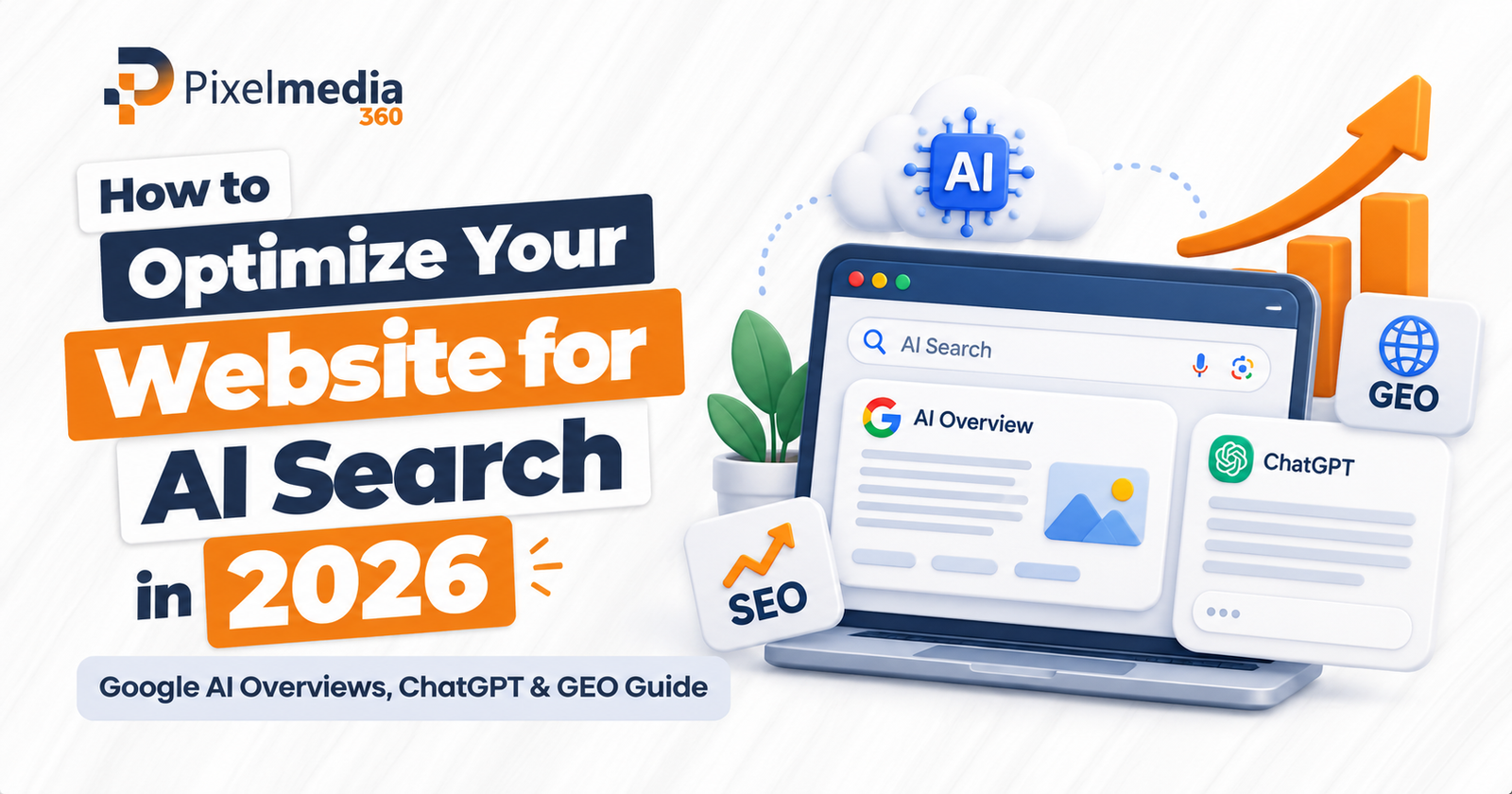
In this guide, Pixel Media 360 explains how AI search works, the differences between SEO, AEO, and GEO, and 10 practical ways to prepare your website for AI-powered discovery in 2026.
What Is AI Search Optimization?
AI search optimization is the process of improving a website’s technical accessibility, content quality, relevance, and discoverability for AI-powered search experiences.
It builds on traditional search engine optimization rather than replacing it.
Traditional SEO primarily focuses on helping web pages become discoverable and competitive in organic search results.
AI search optimization also considers whether information is useful, accessible, and relevant when AI systems generate answers or surface supporting sources.
For example, someone searching for “best SEO services for a small business” may encounter traditional search listings, an AI-generated explanation, or a response containing links to different providers.
Your website should provide reliable information that helps potential customers make informed decisions across these experiences.
However, optimizing your website does not guarantee that an AI system will mention your business or cite your content.
How AI Search Is Changing SEO in 2026
Traditional search and AI-powered search are closely connected, but the way information is presented can differ.
A conventional Google search generally offers a selection of results that users can visit to find answers.
AI-powered experiences can synthesize information from multiple sources and present an answer directly within the interface.
For website owners, this introduces an additional visibility opportunity: being referenced as a source or discovered through an AI-assisted research journey.
Google AI Overviews
Google AI Overviews provide AI-generated summaries for selected searches and may link to supporting websites.
Google explains that its generative search experiences build on existing Search systems, making established SEO practices relevant.
Google AI Mode
Google AI Mode supports more exploratory searches, including complex questions and follow-up queries.
It can use multiple related searches to identify useful information across different aspects of a topic.
ChatGPT Search
ChatGPT search helps users retrieve current information and discover relevant websites through conversational queries.
Website owners can support discoverability by keeping public content accessible and allowing OpenAI’s search crawler where appropriate.
What Does This Mean for Businesses?
A business website should do more than repeat keywords.
It should clearly explain its services, demonstrate relevant expertise, answer important customer questions, and make information easy to discover.
These fundamentals support both traditional search optimization and AI-assisted discovery.
SEO vs AEO vs GEO: What’s the Difference?
SEO, AEO, and GEO are frequently discussed together, but they emphasize different aspects of search visibility.
| Strategy | Full Form | Main Focus |
| SEO | Search Engine Optimization | Organic search visibility |
| AEO | Answer Engine Optimization | Providing clear answers to questions |
| GEO | Generative Engine Optimization | Visibility in AI-generated search experiences |
Search Engine Optimization (SEO)
SEO improves a website’s technical accessibility, content relevance, and overall organic search performance.
It includes keyword research, on-page optimization, technical SEO, internal linking, and content development.
Answer Engine Optimization (AEO)
AEO emphasizes creating content that directly answers relevant user questions.
This may involve descriptive headings, clear explanations, definitions, and useful FAQs.
These are valuable content practices, although adding FAQs or using a question-and-answer format does not automatically produce AI citations.
Generative Engine Optimization (GEO)
GEO is a term used to describe strategies intended to improve a brand’s presence in generative AI experiences.
Such strategies often include improving original content, topical coverage, source accessibility, and business information.
Importantly, Google considers many of these practices part of existing SEO rather than a separate technical requirement.
The strongest approach in 2026 is to build a solid SEO foundation and create genuinely useful information that serves people across different search experiences.
10 Practical Ways to Optimize Your Website for AI Search in 2026
The following strategies can improve your website’s overall search readiness while supporting discoverability across relevant AI search systems.
1. Create Helpful, Original, and Expert-Led Content
High-quality content remains one of the most important elements of an effective search strategy.
Publishing generic articles that repeat information already available across hundreds of websites provides limited value.
Instead, create content that includes:
- Original insights from your industry
- Practical examples and explanations
- Clear comparisons of available solutions
- Relevant research and trustworthy references
- Accurate, regularly reviewed information
- First-hand experience where applicable
For example, a digital marketing agency could publish a guide explaining how a local business improved its website’s technical structure, supported by genuine examples and appropriately documented results.
Original information provides something meaningful beyond a basic summary.
Practical Tip: Include details that reflect your actual experience rather than producing content solely to target search queries.
2. Answer Customer Questions Clearly
Many AI-assisted searches begin with conversational questions.
For example:
- How much does SEO cost in Pakistan?
- Why is my website not ranking on Google?
- Is local SEO suitable for small businesses?
- How can an e-commerce website improve organic visibility?
Your content should address these questions directly.
A useful format is to provide a concise answer at the beginning of a relevant section, followed by additional explanation.
For example:
What is local SEO?
Local SEO is the practice of improving a business’s visibility in location-based search results, including relevant Google Search and Maps experiences.
This approach helps visitors understand information quickly.
However, there is no requirement to divide every paragraph into small sections or follow a special AI content template.
The primary objective should be readability and usefulness.
3. Improve Your Website’s Technical SEO
Search systems need to access and process your website’s content.
Technical problems can prevent pages from being discovered, rendered, or indexed correctly.
Important technical SEO elements include:
- Crawlable internal links
- Appropriate robots.txt rules
- Correct canonical URLs
- Functional XML sitemaps
- Proper indexing directives
- Mobile accessibility
- Reliable server responses
- Accessible HTML content
- Correct redirect configurations
For Google AI Overviews and AI Mode, pages generally need to be indexed and eligible to appear in Google Search with a snippet.
If your pages are blocked from Google Search, they cannot be relied upon to appear as normal supporting links in those AI features.
A professional SEO assessment from Pixel Media 360 can help identify technical barriers affecting your website’s search performance.
4. Build Topical Authority Through Connected Content
Topical authority is commonly used to describe a website’s depth of useful coverage around a particular subject.
Rather than publishing unrelated blog posts, organize content around topics that matter to your audience.
For example, a digital marketing website might develop an SEO content collection covering:
- What is SEO?
- Technical SEO for business websites
- Local SEO strategies
- E-commerce SEO
- SEO keyword research
- Website indexing issues
- AI search optimization
These pages can support one another through relevant internal links.
This structure improves website navigation and helps search engines discover related information.
It also enables users to explore a subject in greater depth.
For a practical example, explore our guide to keyword research for SEO in 2026.
Important: Publishing many articles around similar keywords does not automatically establish authority. Each article should have a distinct purpose and provide meaningful value.
5. Use Structured Data Where Appropriate
Structured data provides machine-readable information about a page’s content.
Schema.org vocabulary can describe entities and content types such as organizations, articles, products, and services.
For a business website, appropriate structured data might include:
- Organization information
- Article details
- Breadcrumb navigation
- Product information where applicable
- Local business details where eligible
Structured data should accurately represent information visible on the page.
It can help Google understand content and support eligibility for certain search features.
However, there is no special GEO schema or AI Overview schema that guarantees inclusion in AI-generated answers.
Structured data is a supporting SEO implementation, not a shortcut to AI visibility.
6. Strengthen Your Brand’s Online Information
Clear, consistent business information helps potential customers identify and evaluate your company.
Your website should accurately communicate:
- Business name
- Main services
- Areas served
- Contact information
- Relevant experience
- Industry expertise
- Verified customer feedback, where available
For local businesses, keep your Google Business Profile accurate and updated.
For example, a business offering SEO services in Islamabad and Rawalpindi should clearly explain its services and service areas.
Avoid creating misleading claims, artificial testimonials, or unnecessary location pages.
A recognizable brand with accurate information across its website and relevant third-party platforms is easier for customers to research.
7. Optimize Content for Semantic Relevance
Semantic SEO focuses on covering a subject clearly and meaningfully rather than relying exclusively on exact-match keywords.
Modern search systems can recognize relationships between concepts and understand many variations of user queries.
For example, an article about AI search optimization may naturally discuss:
- Organic visibility
- Search intent
- AI-generated answers
- Indexing
- Structured data
- Content quality
- Website accessibility
- Topical relevance
These concepts belong together because they help explain the subject.
Instead of inserting the phrase “AI search optimization” repeatedly, use natural language that fully addresses the topic.
Create descriptive headings, explain technical concepts accurately, and link to relevant supporting resources.
The objective is comprehensive, relevant coverage—not keyword stuffing.
8. Make Your Website Accessible to AI Search Crawlers
Different AI search providers may use different discovery and retrieval systems.
For ChatGPT search, OpenAI identifies a crawler called OAI-SearchBot.
Website owners who want their publicly available content to be eligible for inclusion in ChatGPT search summaries and snippets should ensure that this crawler is not blocked.
Review:
- Robots.txt restrictions
- CDN and firewall configurations
- Bot protection rules
- Server response codes
- Public page accessibility
Be aware that OAI-SearchBot and GPTBot serve different purposes.
OAI-SearchBot supports search discovery, while GPTBot relates to potential model training.
Allowing search crawling does not require allowing training crawling.
Even when a website is accessible, appearance in ChatGPT search results is not guaranteed.
9. Support Content With Useful Images and Videos
Search experiences increasingly support information beyond plain text.
Relevant images, videos, charts, and diagrams can make complex subjects easier to understand.
For example, a technical SEO guide may benefit from:
- A website architecture diagram
- An indexing workflow illustration
- A genuine Google Search Console screenshot
- A crawlability checklist
- An explanatory video
Use descriptive image file names and accurate alt text.
Ensure essential written information remains accessible as text rather than appearing only inside images.
Google recommends supporting textual content with useful visual media when appropriate.
However, adding images merely for decoration does not guarantee stronger AI search visibility.
10. Monitor AI Search Visibility and Business Performance
AI search optimization needs ongoing measurement.
Traditional SEO reporting commonly includes organic traffic, search impressions, keyword performance, and conversions.
AI-related monitoring may additionally examine:
- Mentions of your brand in relevant AI search responses
- Citations linking to your website
- AI search referral traffic
- Leads generated from AI-assisted visits
- Changes in search visibility for important topics
Google Search Console provides information about Search performance, including available reporting for generative AI experiences.
For ChatGPT search referrals, analytics tools can identify traffic containing the utm_source=chatgpt.com parameter.
AI responses can vary across users, prompts, and sessions.
Therefore, occasional manual visibility checks should be treated as observations rather than definitive rankings.
Most importantly, evaluate whether search visibility contributes to relevant enquiries and business results.
Does Traditional SEO Still Matter in 2026?
Yes. Traditional SEO remains important.
Google’s official guidance explains that its AI-powered Search features use foundational Search systems.
That means technical accessibility, relevant content, internal linking, and overall website quality continue to matter.
Businesses should avoid abandoning established SEO practices in favor of unverified AI optimization techniques.
A sustainable strategy should combine:
Technical SEO + Helpful Content + Semantic Relevance + Clear Brand Information + Performance Measurement
These elements create a stronger foundation for organic visibility across conventional and AI-powered search experiences.
Common AI Search Optimization Mistakes to Avoid
As interest in GEO and AEO grows, misleading optimization claims are becoming common.
Businesses should avoid the following mistakes.
Publishing mass-produced content without adding value: Generating large volumes of repetitive articles can create quality problems and may violate search spam policies.
Creating special AI files without a clear purpose: Google does not require llms.txt or dedicated AI markup to appear in its generative search features.
Using irrelevant schema markup: Structured data should represent actual page content rather than attempt to manipulate search systems.
Ignoring traditional SEO: AI search visibility does not remove the need for crawling, indexing, useful content, and accessible websites.
Promising guaranteed AI citations: Neither Google nor ChatGPT provides a guaranteed organic placement method.
Measuring only mentions: Business owners should evaluate qualified traffic, conversions, and customer enquiries alongside AI search visibility.
The objective is to improve your website’s genuine usefulness and accessibility rather than pursue shortcuts.
How Pixel Media 360 Can Help Improve Your Search Visibility
At Pixel Media 360, we understand that digital visibility extends beyond publishing content and targeting keywords.
Businesses need websites that are technically accessible, useful to their audiences, and aligned with search behavior.
Our digital marketing services include:
- Search Engine Optimization
- Technical SEO
- Keyword Research
- On-Page SEO
- Content Marketing
- Local SEO
- E-commerce SEO
- Website Development
- Link Building
Our approach combines technical website improvements, relevant content strategies, and performance measurement to help businesses strengthen their online presence.
Whether your company targets customers in Islamabad, Rawalpindi, across Pakistan, or internationally, an effective search strategy begins with understanding your business and your audience.
Explore our professional SEO services and digital marketing solutions to learn more.
Frequently Asked Questions About AI Search Optimization
1. What is AI search optimization?
AI search optimization involves improving a website’s content, technical accessibility, relevance, and discoverability to support visibility across AI-powered search experiences.
2. What is the difference between SEO and GEO?
SEO broadly focuses on organic search visibility. GEO is a term commonly used for strategies targeting visibility in generative AI experiences. Many GEO practices overlap with established SEO fundamentals.
3. How can I optimize my website for Google AI Overviews?
Ensure important pages are indexed, accessible, and eligible to appear in Google Search with snippets. Create useful original content, improve internal linking, and maintain a good page experience. Google does not require special AI-specific markup.
4. How can my website appear in ChatGPT search results?
Make relevant public pages accessible and ensure OAI-SearchBot is permitted to crawl them. Publish accurate and useful information. These steps support eligibility but do not guarantee inclusion or citations.
5. Is AEO different from traditional SEO?
AEO emphasizes answering user questions clearly. This is compatible with established SEO and content best practices rather than necessarily requiring a separate technical system.
6. Does schema markup improve AI search rankings?
Appropriate structured data helps search engines interpret website information and may support eligible search features. There is no evidence that adding a special AI schema guarantees placement in generative answers.
7. Is AI-generated content bad for SEO?
Not automatically. AI tools can support research, editing, and content development. The important considerations are accuracy, originality, relevance, and usefulness. Publishing large volumes of low-value automated content can create search quality and policy problems.
8. How long does AI search optimization take to show results?
There is no fixed timeline. Improvements depend on crawling, indexing, content quality, competition, platform behavior, and the website’s existing visibility. Results should be evaluated over time using appropriate analytics.
Final Thoughts
AI search optimization in 2026 is not about replacing SEO. It is about making your website more useful, accessible, and discoverable across evolving search experiences.
Google AI Overviews, Google AI Mode, and ChatGPT search create additional ways for customers to discover information and evaluate businesses.
Companies that invest in original content, sound technical SEO, clear service information, and accurate measurement can establish a stronger foundation for long-term online visibility.
There is no guaranteed formula for appearing in AI-generated answers, but there are practical steps businesses can take to improve their search readiness.
Ready to Strengthen Your Website’s Search Visibility?
Pixel Media 360 helps businesses develop SEO strategies built around technical performance, content quality, and measur’able growth.