


SEO in 2026 involves far more than checking rankings or adding keywords to a page. Businesses and SEO professionals need reliable information about search visibility, indexing, technical performance, user behaviour, backlinks, competitors, and content opportunities.
The right SEO tools make those tasks easier, but no platform can replace strategy or professional judgement. Google’s current Search guidance continues to emphasise helpful, reliable, people-first content and recommends using the words people search for naturally in important locations such as titles, headings, links, and alt text.
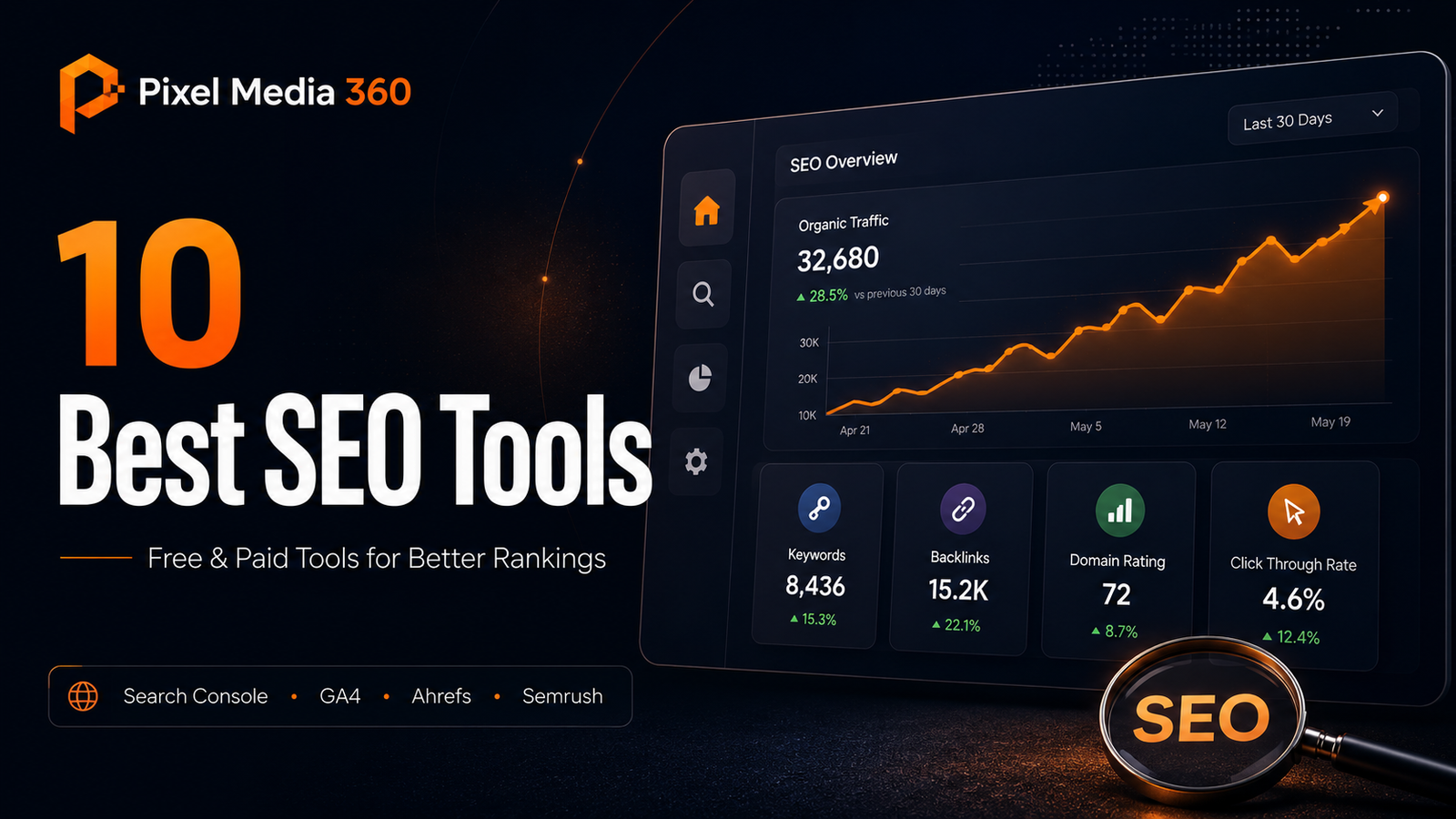
This guide covers 10 of the Best SEO Tools available in 2026, including free Google platforms and professional tools for keyword research, technical SEO, website auditing, backlink analysis, and competitor research.
Table of Content
- How We Selected These SEO Tools
- Google Search Console
- Google Analytics 4
- Google Keyword Planner
- Google Trends
- PageSpeed Insights
- Screaming Frog SEO Spider
- Ahrefs
- Semrush
- SE Ranking
- Ubersuggest
- Which SEO Tools Do You Actually Need?
- Common Mistakes When Using SEO Tools
- Final Thoughts
- Frequently Asked Questions
How We Selected These SEO Tools
The tools below were selected based on the SEO tasks they support rather than popularity alone.
A useful SEO toolkit should help answer questions such as:
- Is Google finding and indexing important pages?
- Which searches generate impressions and clicks?
- What happens after users land on the website?
- Which keywords are worth targeting?
- Are technical issues affecting performance?
- How strong is the website’s backlink profile?
- What are competitors ranking for?
- Which SEO opportunities should be prioritised?
Another important distinction is data ownership. First-party tools such as Google Search Console provide information directly about your own Google Search performance, while platforms such as Ahrefs, Semrush, and SE Ranking use their own databases and estimates. Both types of data are useful, but they should not be treated as identical.
1. Google Search Console
Google Search Console is one of the most important free SEO tools for any website that depends on organic search.
It helps website owners monitor Google Search performance, identify indexing issues, submit sitemaps, and inspect individual URLs. Its Performance report shows metrics such as search queries, impressions, clicks, and search performance over time.
The URL Inspection tool is particularly useful when an important page is not appearing in search. It provides information about Google’s indexed version of a URL and can test whether a page may be indexable.
Best for:
Search performance, indexing, crawl monitoring, and first-party Google data.
Why it matters:
Before relying on third-party estimates, SEO professionals should understand what Google itself is reporting about the website.
2. Google Analytics 4
Google Analytics 4, or GA4, helps answer a different question: what happens after visitors reach the website?
Google describes Analytics as a platform for understanding website and app performance and using that information to improve digital strategy.
For SEO, GA4 can help analyse:
- Organic traffic
- Landing-page engagement
- Events
- Key actions
- Ecommerce behaviour
- Traffic sources
- User journeys
Search Console may show that a page receives organic clicks, while GA4 helps determine whether those visitors actually engage with the site or complete valuable actions.
Best for:
Traffic analysis, user behaviour, and conversion measurement.
Professional tip:
Do not judge SEO success only by rankings. A lower-traffic page that produces qualified leads may be more valuable than a high-traffic article that generates no meaningful action.
3. Google Keyword Planner
Google Keyword Planner is primarily designed for Google Ads, but it can also support SEO research.
It allows marketers to discover new keyword ideas and view estimates of monthly searches and advertising costs.
As one of the most accessible keyword research tools, it is useful for identifying:
- Related search terms
- Commercial keyword ideas
- Geographic demand
- Topic variations
- Search-volume estimates
However, Google Ads competition should not be confused with organic SEO difficulty. They measure different environments.
Best for:
Initial keyword research and commercial search discovery.
The best approach is to combine Keyword Planner data with search intent, competitor analysis, and the relevance of each keyword to your actual business.
4. Google Trends
Google Trends helps marketers understand how search interest changes over time and across locations. Google describes it as a way to explore what people are searching for and examine interest in topics and terms by time and geography.
It can be particularly useful for:
- Seasonal keywords
- Emerging topics
- Declining search interest
- Regional comparisons
- Content planning
Suppose two keywords appear equally attractive in another SEO tool. Trends may reveal that one is growing while the other has been steadily declining.
Best for:
Trend analysis, seasonal SEO, and topic validation.
Among Google SEO tools, Trends is especially valuable when historical search volume alone does not provide enough context.
5. PageSpeed Insights
PageSpeed Insights helps evaluate website performance across devices and is one of the most useful free SEO tools for website performance analysis. Google positions the tool as a way to improve web-page speed across devices.
SEO and development teams commonly use it when investigating:
- Core Web Vitals
- Loading performance
- Layout stability
- Responsiveness
- Heavy scripts
- Large images
- Performance bottlenecks
Best for:
Page performance and Core Web Vitals investigation.
A common mistake is trying to achieve a perfect tool score instead of improving actual user experience. Use the recommendations to diagnose meaningful performance problems, then prioritise fixes based on real pages and business importance.
6. Screaming Frog SEO Spider
Screaming Frog is one of the most established technical SEO tools for crawling websites.
Its SEO Spider can audit hundreds of potential SEO and UX issues, while the free version currently allows users to crawl up to 500 URLs.
It can help identify:
- Broken links
- Redirect chains
- Missing titles
- Duplicate metadata
- Canonical issues
- Internal linking problems
- Status codes
- Indexability issues
- Website architecture problems
Best for:
Technical SEO audits, migrations, and large-scale website analysis.
Screaming Frog is more useful than a basic website SEO checker when you need to analyse many URLs together rather than inspect individual pages manually.
7. Ahrefs
Ahrefs is widely used for backlink analysis, keyword research, competitor research, and site auditing.
Its Webmaster Tools currently provide access to Site Audit, Site Explorer, and web analytics features for verified websites. Ahrefs says its Site Audit can scan for more than 170 technical and on-page SEO issues.
As a backlink checker, Ahrefs can help analyse:
- Referring domains
- Linking pages
- Competitor backlinks
- Lost and new links
- Organic keywords
- Content gaps
Best for:
Backlink research, competitor analysis, and SEO opportunity discovery.
Do not evaluate a backlink only by a third-party authority score. Relevance, editorial context, website quality, and the reason the link exists should also influence your assessment.
8. Semrush
Semrush offers a broad set of SEO analysis tools for research, monitoring, auditing, and competitor analysis.
Its SEO toolkit includes keyword research, backlink tools, rank tracking, on-page analysis, and technical SEO auditing.
It is especially useful for teams that want several SEO functions inside a single platform.
Common use cases include:
- Keyword gap analysis
- Competitor research
- Rank tracking
- Site audits
- Backlink analysis
- On-page recommendations
Best for:
Agencies, marketing teams, and businesses managing multiple SEO activities.
The biggest risk with comprehensive tools is information overload. Thousands of keyword suggestions do not mean thousands of keywords should be targeted. Search intent and business relevance still matter.
9. SE Ranking
SE Ranking combines rank tracking, website auditing, backlink monitoring, competitor analysis, and on-page SEO features within one platform.
Its current offering also includes capabilities around AI-search visibility alongside traditional SEO workflows, reflecting how professional search monitoring is expanding beyond standard blue-link rankings.
Best for:
Rank tracking, multi-project SEO management, audits, and agency reporting.
It can be particularly useful for professionals managing multiple websites because tracking, auditing, and reporting can be handled within the same environment.
10. Ubersuggest
Ubersuggest provides keyword research, competitor analysis, site audits, and other SEO features through a relatively straightforward interface. Its official site describes it as a tool for keyword research, competitor analysis, and website auditing.
For businesses that are not ready for a complex enterprise SEO platform, it can provide a more accessible introduction to:
- Keyword opportunities
- Competitor research
- SEO audits
- Backlinks
- Ranking data
Best for:
Small businesses, content marketers, and beginner-to-intermediate SEO users.
Ubersuggest should still be used as a research tool rather than a substitute for Search Console, analytics, or professional SEO judgement.
Which SEO Tools Do You Actually Need?
You probably do not need all 10 tools.
For a small business, a practical starting stack could be:
Google Search Console + GA4 + Keyword Planner + PageSpeed Insights
For an SEO professional managing larger projects:
Search Console + GA4 + Screaming Frog + Ahrefs or Semrush
For technical SEO work:
Search Console + Screaming Frog + PageSpeed Insights
For competitor and backlink research:
Ahrefs, Semrush, or SE Ranking
The right combination depends on the size of the website, available budget, technical complexity, and the decisions you need the data to support.
Common Mistakes When Using SEO Tools
SEO software can identify problems, but it cannot automatically decide what deserves priority.
Avoid these common mistakes:
- Following every automated recommendation without review
- Treating third-party metrics as official Google metrics
- Selecting keywords only because they have high search volume
- Measuring success only through rankings
- Running SEO audits without implementing fixes
- Buying multiple platforms that provide overlapping data
- Focusing on scores instead of user and business outcomes
The strongest SEO workflow combines reliable data, search intent, technical understanding, content quality, and professional judgement.
Final Thoughts
The best SEO tools in 2026 are not necessarily the ones with the most features. The most useful tools are the ones that help you understand what is happening on your website and make better decisions based on reliable data.
Google Search Console and GA4 give you first-party insights into search visibility and user behaviour. Keyword Planner and Google Trends help with search research, while PageSpeed Insights and Screaming Frog are useful for performance and technical SEO checks. Tools such as Ahrefs, Semrush, SE Ranking, and Ubersuggest add deeper competitor, backlink, keyword, and website analysis.
The key is to use these tools as part of a broader SEO strategy. Good software can highlight problems and opportunities, but it cannot replace useful content, technical accuracy, relevant expertise, and a clear understanding of what your audience is searching for.
If your SEO tools are showing issues that are difficult to prioritise or fix, you can Contact Pixel Media 360
Frequently Asked Questions
What are the best SEO tools to use in 2026?
The best SEO tools depend on your needs. Google Search Console and GA4 are essential for first-party performance data, while Screaming Frog is strong for technical SEO. Ahrefs, Semrush, and SE Ranking are useful for keyword research, competitor analysis, backlink checks, and rank tracking.
Are there any free SEO tools for websites?
Yes. Useful free SEO tools include Google Search Console, Google Analytics 4, Google Keyword Planner, Google Trends, and PageSpeed Insights. These tools can help with search performance, keyword research, website traffic, technical monitoring, and page-speed analysis.
Which SEO tool is best for keyword research?
Google Keyword Planner is useful for basic keyword discovery, while Ahrefs, Semrush, and SE Ranking provide more advanced keyword research features. The best option depends on your budget, target market, and whether you also need competitor and ranking data.
What is the best tool for technical SEO audits?
Screaming Frog SEO Spider is one of the most practical technical SEO tools for crawling websites and identifying issues such as broken links, redirects, missing metadata, canonical problems, and internal-linking issues. Google Search Console is also valuable for indexing and search-performance checks.
Which SEO tool is best for checking backlinks?
Ahrefs is widely used as a backlink checker because it helps analyse referring domains, linking pages, competitor backlinks, and lost or newly discovered links. Semrush and SE Ranking also provide backlink-analysis features.
Can SEO tools improve Google rankings?
SEO tools can identify opportunities and problems, but they cannot guarantee higher rankings. Rankings depend on factors such as search intent, content quality, technical SEO, website authority, internal linking, backlinks, competition, and overall user experience. Tools provide data; strategy and implementation create results.
Do I need to use all 10 SEO tools?
No. Most businesses do not need every tool on this list. A smaller stack such as Google Search Console, GA4, PageSpeed Insights, and one advanced SEO platform can cover many essential tasks. Larger websites and SEO professionals may need additional technical and competitor-analysis tools.
What is the difference between Google SEO tools and third-party SEO tools?
Google tools such as Search Console and GA4 provide first-party data related to your own website. Third-party platforms such as Ahrefs, Semrush, and SE Ranking use their own databases and estimates to provide competitor, keyword, backlink, and ranking insights. Using both types together creates a more complete SEO workflow.