


In today’s digital marketplace, having a website is only the starting point. If potential customers cannot find your business through search, your online presence has limited commercial value. Whether you operate a retail business in Rawalpindi, a professional services firm in Islamabad, or a growing company serving customers across Pakistan, search visibility can directly influence brand awareness, lead generation, and long-term growth.
This guide explains Search Engine Optimization (SEO), how search engines discover and rank web pages, and how businesses can build a structured strategy for stronger organic visibility. For specialist support, Pixel Media 360 SEO services cover technical SEO, keyword research, on-page optimization, content strategy, local SEO, and link building.
What Is SEO?
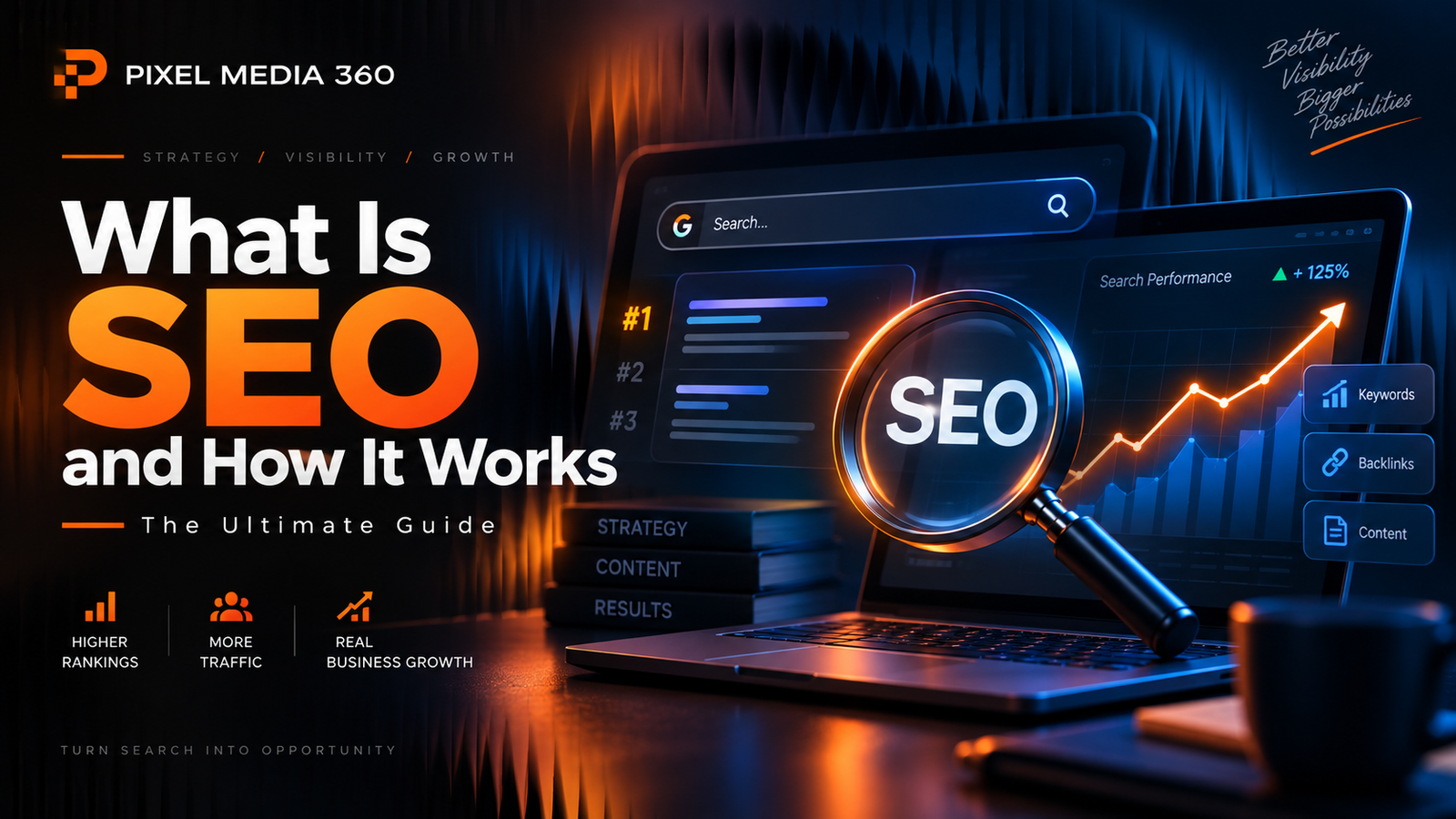
Search Engine Optimization (SEO) is the process of improving a website so that search engines can discover, understand, and rank its pages more effectively. The objective is to increase qualified organic visibility for searches that are relevant to a business, product, service, or topic.
Unlike pay-per-click advertising, where visibility is purchased through media spend, SEO earns organic traffic through technical quality, relevant content, strong user experience, and credible authority signals. An effective SEO program therefore combines website performance, search intent, content strategy, and reputation building rather than relying on a single tactic.
Why SEO Matters for Businesses in Rawalpindi and Islamabad
Competition across Rawalpindi and Islamabad continues to increase in sectors such as real estate, technology, healthcare, education, professional services, retail, hospitality, and e-commerce. Search engines are often one of the first places customers use to compare providers, assess credibility, and make purchasing decisions.
A customer searching for terms such as “digital marketing agency in Rawalpindi” or “SEO services in Islamabad” is already demonstrating commercial intent. Businesses that consistently appear for relevant searches are better positioned to capture enquiries before competitors do.
For location-focused businesses, Local SEO is particularly important because it improves visibility for geographic searches, Google Maps results, and “near me” queries. The objective is not simply to attract more website visits, but to reach people who are more likely to contact, visit, or purchase from the business.
How Search Engines Work: The Three Core Stages
SEO becomes easier to understand once the search engine process is clear. Search engines use automated systems to discover web pages, interpret their content, and determine which results are most useful for a particular query. At a high level, the process consists of three connected stages:
- Crawling: Search engines use automated crawlers to discover new or updated URLs and retrieve page content, links, images, and technical signals.
- Indexing: Eligible pages are processed and stored in the search engine index. A page that cannot be indexed will not normally appear in organic search results.
- Ranking: When a user searches, the search engine evaluates indexed pages against relevance, quality, usability, and authority signals to determine the order of results.
SEO work is commonly organized into three connected areas: Technical SEO, On-Page SEO, and Off-Page SEO. Each supports a different part of the search visibility process.
Technical SEO: Building the Foundation
Technical SEO focuses on the infrastructure that allows search engines to access, render, understand, and index a website efficiently. Strong content can still underperform when a site has crawl barriers, slow performance, duplicate URLs, weak internal architecture, or indexation problems.
- Mobile usability: Pages should be responsive, readable, and easy to navigate across modern smartphones and tablets.
- Page speed and Core Web Vitals: Efficient images, scripts, caching, hosting, and front-end code can improve loading performance and user experience.
- HTTPS and site security: Secure connections protect data in transit and represent a basic trust and technical quality standard for modern websites.
- XML sitemaps and robots.txt: These files help search engines discover important URLs and understand which areas of a site should or should not be crawled.
- Indexation and canonicalization: Canonical tags, redirects, status codes, and index directives should be configured to reduce duplicate content and prevent important pages from being excluded.
- Site architecture and internal linking: A logical hierarchy helps users and search engine crawlers reach important pages efficiently.
A professional technical audit should prioritize issues by severity and business impact rather than treating every warning as equally important. Pixel Media 360’s SEO services include technical analysis alongside on-page and authority-focused optimization.
On-Page SEO: Content and Relevance
On-Page SEO improves the relevance, clarity, and usefulness of individual web pages. It aligns page content with the language people use in search while ensuring the information genuinely satisfies the user’s intent.
- Keyword research and search intent: Identify the topics, questions, services, and commercial terms your audience searches for, then match each target keyword to the correct type of page.
- Title tags and meta descriptions: Write clear, specific search snippets that accurately describe the page and encourage qualified clicks.
- High-quality content: Publish original, useful content that answers the search query thoroughly without unnecessary repetition or keyword stuffing.
- Heading structure: Use a logical H1, H2, and H3 hierarchy so readers and search engines can understand the page structure.
- Internal linking: Connect related service pages, blogs, categories, and resources so authority and context flow naturally throughout the website.
- Images and media: Compress files, use descriptive alternative text where appropriate, and ensure media supports rather than slows the page experience.
The strongest on-page strategy is built around topics, relevance, and user intent rather than isolated keyword-density targets. Search engines increasingly favor pages that demonstrate depth, clarity, and genuine usefulness.
Off-Page SEO: Authority and Trust
Off-Page SEO covers signals developed beyond your own website that help establish authority, reputation, and relevance. Backlinks remain an important part of this work, but effective authority building extends beyond simply acquiring links.
- Link building: Relevant, editorially earned backlinks from credible websites can strengthen authority and improve discovery. Quality, topical relevance, and placement matter more than raw link volume.
- Local citations and business profiles: Consistent business information across trusted directories and platforms supports local visibility and entity confidence.
- Google Business Profile: Accurate categories, services, images, updates, reviews, and location information can strengthen local search and Google Maps visibility.
- Digital PR and brand mentions: Media coverage, industry references, partnerships, and expert contributions can expand reach and support authority even when every mention does not include a backlink.
- Social distribution: Social platforms can increase content exposure, referral visits, brand discovery, and the probability of earning natural mentions and links.
Businesses that require a structured authority strategy can review Pixel Media 360’s Link Building services, which focus on relevant outreach, content placement, and sustainable backlink growth.
SEO Strategy for Local Success
SEO produces stronger results when activities are prioritized in the right order. For businesses targeting Rawalpindi, Islamabad, and surrounding areas, the following workflow provides a practical foundation for sustainable organic growth.
Run a Comprehensive Website Audit
Review crawlability, indexation, page speed, mobile usability, site architecture, broken links, redirects, metadata, duplicate content, internal linking, and analytics configuration. Google Search Console and Google Analytics should be used to establish a measurable baseline.
Build a Strategic Keyword Map
Group keywords by search intent and assign them to appropriate pages. Combine broader commercial terms with location-based and long-tail queries that reflect how customers search in Rawalpindi, Islamabad, and nearby markets.
Optimize Existing Pages and Create Missing Content
Improve service pages, location pages, category pages, FAQs, and blog content based on identified search opportunities. Avoid creating multiple thin pages that target nearly identical terms; each page should serve a distinct purpose and provide clear value.
Strengthen Local and Off-Page Authority
Optimize the Google Business Profile, improve citation consistency, earn relevant links, collect genuine customer reviews, and build local brand mentions. For location-led campaigns, Pixel Media 360’s Local SEO service can support this process.
Track Performance and Refine the Strategy
Monitor organic clicks, impressions, rankings, conversions, indexed pages, local visibility, and lead quality. SEO is an iterative process; use performance data to expand what works and correct what does not.
Frequently Asked Questions
How long does it take to see results from SEO?
SEO is a long-term growth channel. Many websites begin to see measurable improvements within three to six months, but the timeline varies according to the site’s current condition, competition, authority, market size, and consistency of implementation. Technical corrections can produce faster changes, while competitive commercial terms often require sustained work.
Is Local SEO different from traditional SEO?
Yes. Traditional SEO may target national or international organic results, while Local SEO focuses on visibility within a defined geographic market. It places greater emphasis on Google Business Profile optimization, local citations, reviews, location signals, local content, and map visibility. Businesses targeting the twin cities can use a dedicated local strategy to compete more effectively for location-based searches.
Can I manage SEO for my business myself?
Basic content updates, metadata improvements, internal linking, and Google Business Profile management can be handled in-house when the necessary time and expertise are available. More complex work, including technical audits, large-scale site migrations, advanced keyword architecture, structured data, link acquisition, and recovery from indexing problems, often benefits from specialist expertise. Businesses that require professional support can review Pixel Media 360 SEO services or use the contact page for project enquiries.
Conclusion
Search Engine Optimization is a core component of sustainable digital growth. A website that is technically accessible, aligned with search intent, supported by useful content, and strengthened by credible authority signals has a significantly better chance of earning consistent organic visibility.
For businesses in Rawalpindi and Islamabad, the strongest approach combines technical SEO, on-page optimization, local search strategy, and ongoing authority building. The objective should not be rankings alone; it should be qualified visibility that contributes to enquiries, sales, and measurable business growth.
Pixel Media 360 provides integrated SEO and digital marketing services for businesses seeking structured, performance-focused online growth.