
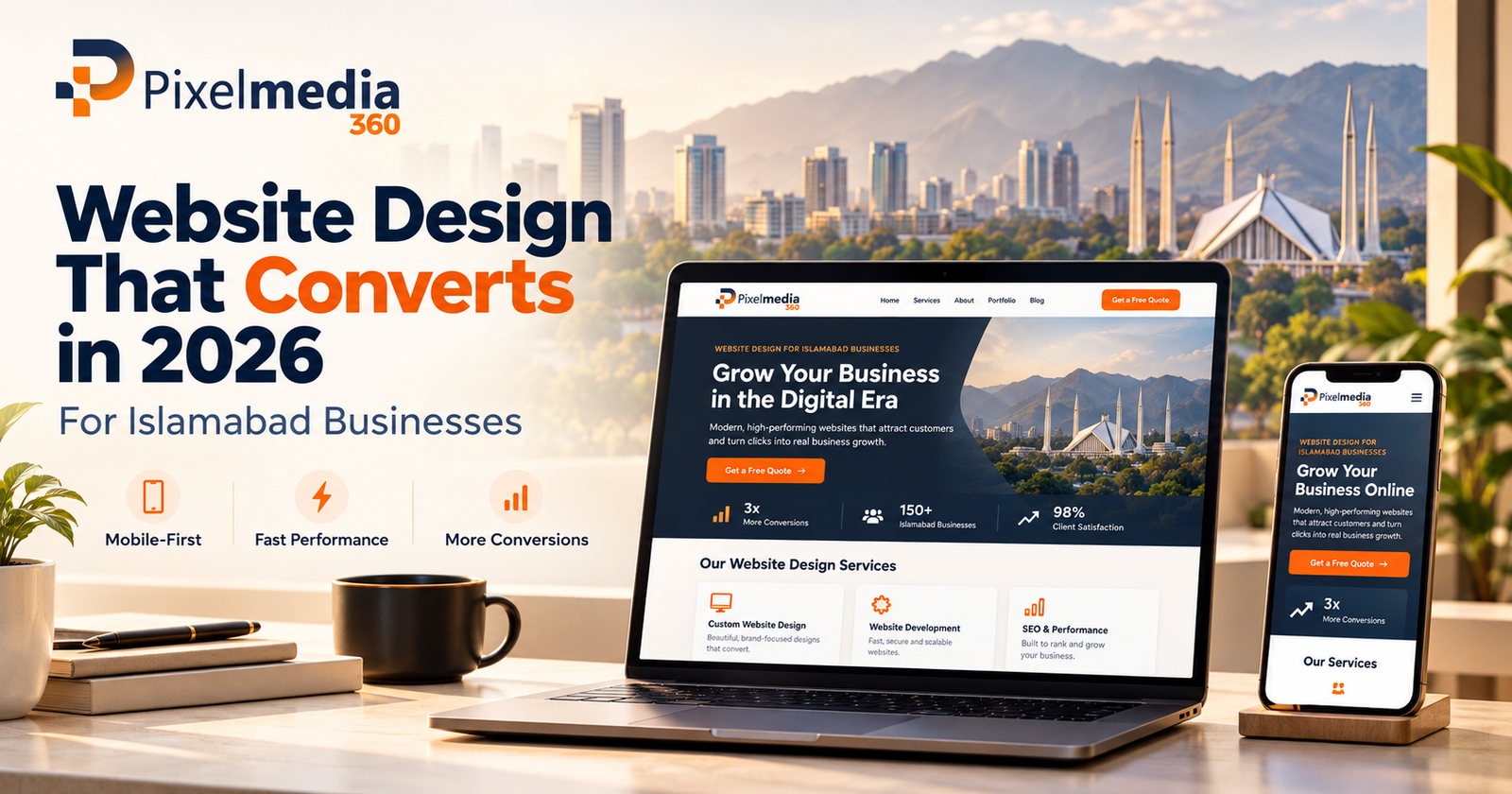
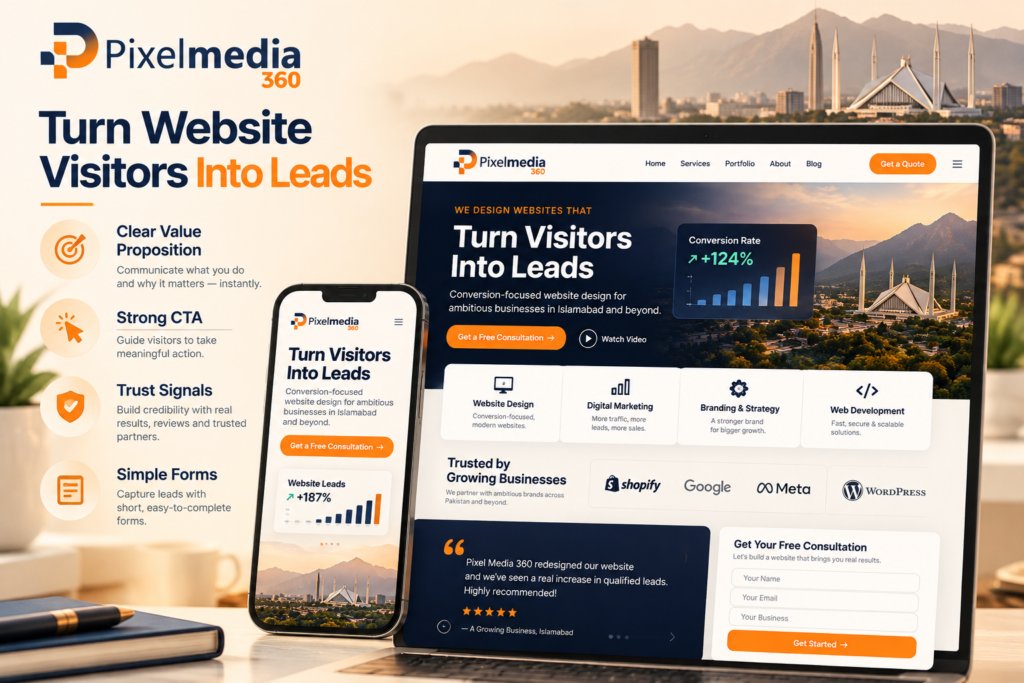
A modern business website should do more than look professional. It should communicate value quickly, build trust, make information easy to find, perform well across devices, and guide visitors toward a meaningful action.
For businesses in Islamabad, that action may be requesting a consultation, calling an office, submitting an enquiry, booking an appointment, visiting a location, or completing a purchase.
That distinction matters in 2026. A visually attractive website that generates little engagement or few enquiries is not performing as a serious business asset.
Google’s current guidance also continues to emphasize an overall strong page experience, including good Core Web Vitals, mobile usability, secure delivery, and pages where users can easily distinguish the main content. Google does not treat page experience as one isolated ranking signal; it evaluates multiple signals and the usefulness of the page as a whole. Google for Developers
For Islamabad businesses planning a new website or redesign, the objective should therefore be clear: build for users, search visibility, trust, and conversion at the same time.
Table of Contents
- Why Website Design Matters for Islamabad Businesses in 2026
- What Does a Conversion-Focused Website Mean?
- Start With a Clear Value Proposition
- Design for Mobile Users First
- Build Simple and Intentional Navigation
- Make Calls to Action Easy to Find
- Use Trust Signals Strategically
- Website Speed and Page Experience
- Write Website Copy That Supports Conversion
- Design for SEO From the Beginning
- Local SEO for Islamabad Businesses
- Prepare Your Website for AI-Powered Search
- Forms and Landing Pages That Convert
- Choosing the Right Website Platform
- Common Website Design Mistakes
- How to Measure Website Performance
- Frequently Asked Questions
- Final Thoughts
Why Website Design Matters for Islamabad Businesses in 2026
Islamabad has a highly competitive commercial environment spanning technology companies, consultants, real estate firms, healthcare providers, educational institutions, professional services, hospitality businesses, retailers, and emerging startups.
A 2026 Websouls research project covering businesses across Pakistan reported that 58.3% of the 389 Islamabad businesses in its city sample had a dedicated website, while others relied on social pages or had no website presence. The study is an independent industry dataset rather than official government data, but it illustrates how established web presence has become across the local market.
Simply owning a website is therefore no longer enough to differentiate a business.
The more important questions are whether the site is easy to understand, fast, mobile-friendly, trustworthy, searchable, and capable of turning visitors into enquiries or customers.
This is where conversion-focused website design becomes important.
Pixel Media 360’s Website Development services are structured around responsive design, performance, SEO-friendly development, security, scalability, and conversion rather than appearance alone.
What Does a Conversion-Focused Website Mean?
A conversion-focused website is designed around the action the business wants visitors to complete.
Conversion does not always mean an online purchase.
For an Islamabad law firm, a conversion might be a consultation request. For a real estate company, it may be a property enquiry. For a clinic, it could be an appointment booking. For a software company, it might be a demo request.
Good conversion design reduces unnecessary friction between user intent and that final action.
Every important page should quickly answer three questions:
What does this business offer?
Why should I trust it?
What should I do next?
If visitors have to search through multiple sections before they can understand those answers, the website structure needs improvement.
Start With a Clear Value Proposition
The first visible section of a website carries significant responsibility.
A homepage should not begin with vague statements such as:
“Welcome to our website.”
“Your trusted business partner.”
“We deliver excellence.”
These phrases provide little useful information because almost any business could use them.
Instead, the headline and supporting copy should explain the offer and audience clearly.
A strong homepage introduction for an Islamabad-based accounting company might explain that the firm provides accounting, tax, payroll, and advisory services for SMEs in Islamabad and Rawalpindi.
That immediately gives both the visitor and search engine meaningful context.
Clarity normally converts better than clever wording that requires interpretation.
Design for Mobile Users First
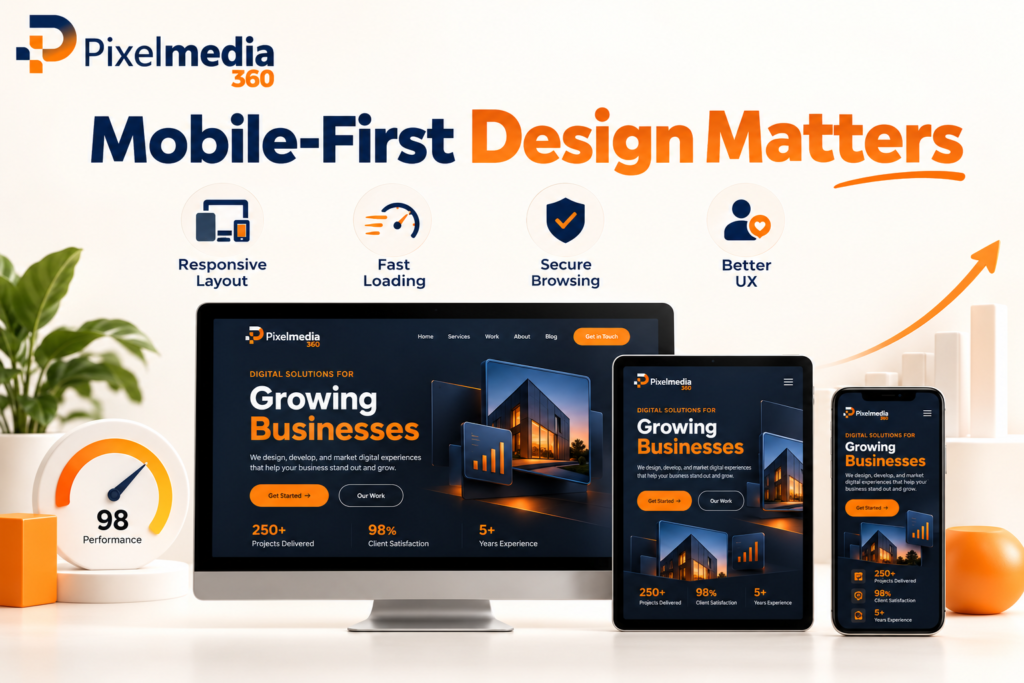
A website may look polished on a large desktop monitor while becoming difficult to use on a smartphone.
That is unacceptable for a modern business website.
Mobile design should be considered during the original design process rather than treated as a smaller version of the desktop website.
Buttons need adequate spacing. Text needs to remain readable. Forms should be simple to complete. Menus should be easy to operate. Images should resize properly. Important contact actions should not disappear below unnecessary visual elements.
Google recommends that pages display well across devices as part of providing a strong overall page experience.
Mobile usability also affects business outcomes directly. A potential customer searching for a nearby service from their phone should be able to understand the company and contact it without fighting the interface.
Build Simple and Intentional Navigation
Navigation is not where businesses should try to be creative.
Users expect predictable website structures.
Home, About, Services, Portfolio or Case Studies, Blog, and Contact are familiar because they work.
A business with multiple services can create a logical hierarchy underneath the main Services section rather than crowding every service into the primary menu.
A website should make important commercial pages accessible without requiring visitors to repeatedly guess where information is located.
Clear navigation also supports crawling and internal linking because search engines can discover important pages more efficiently.
For example, a web-development company may organize its service architecture around custom development, WordPress development, eCommerce development, and landing pages rather than placing every offer into unrelated areas of the website.
Make Calls to Action Easy to Find
Every commercial page needs a logical next step.
A CTA might say:
Request a Consultation
Get a Website Audit
Book an Appointment
Get a Quote
Speak With Our Team
The important principle is consistency.
Visitors should not encounter five competing actions in the same section.
The primary CTA should correspond with the purpose of that page.
For a campaign-specific page, Pixel Media 360’s Landing Page Design services provide a useful example of treating landing pages as dedicated conversion assets rather than generic website pages.
Use Trust Signals Strategically
Visitors evaluate credibility before they enquire.
Trust should therefore be demonstrated, not merely claimed.
Relevant signals can include client logos, genuine testimonials, case studies, team information, physical business details, recognised certifications, project examples, transparent contact information, and evidence of previous work.
Placement matters.
If a website makes a major claim, supporting evidence should appear close to that claim.
A sentence such as “Trusted by leading businesses” becomes far more credible when accompanied by actual companies, projects, results, or case studies.
Avoid fake reviews, fabricated statistics, stock testimonials, or unsupported performance claims. Short-term visual credibility is not worth long-term reputational risk.
Website Speed and Page Experience
Complex animations, oversized images, unnecessary plugins, autoplaying media, poorly implemented fonts, and bloated scripts can make an impressive website frustrating to use.
Website performance should therefore be part of the design process.
Google recommends good Core Web Vitals and an overall page experience that works well on mobile devices, uses secure connections, avoids intrusive interruptions, and makes the main content easy to identify. Google also makes clear that achieving perfect technical scores alone does not guarantee rankings.
For businesses, this is the correct way to think about performance:
Speed supports usability. Usability supports engagement. Engagement supports conversion.
Performance optimisation should include the design, code, images, hosting environment, scripts, and plugins rather than relying on one optimisation plugin after the site is finished.
Write Website Copy That Supports Conversion
Design controls attention. Copy explains why the visitor should act.
Both need to work together.
A website can be visually excellent while failing commercially because the copy is vague, overly corporate, or written entirely around the company instead of the customer.
Service pages should explain the problem being solved, the service being offered, who it is suitable for, what makes the approach credible, and the next logical action.
Headings should communicate meaning even when someone scans the page quickly.
Businesses rebuilding weak service pages can also connect design work with professional Website Copywriting services so messaging, page hierarchy, search intent, and conversion goals support one another.
Design for SEO From the Beginning
SEO should not be added after the website launches.
Site architecture, URL structure, heading hierarchy, internal links, page templates, image handling, mobile responsiveness, structured data, canonicalisation, crawlability, and page speed can all be influenced during development.
A website built without SEO considerations can create avoidable problems later.
Businesses should therefore connect web development with a broader SEO strategy from the planning stage.
Search optimisation should also remain natural.
A business does not need to repeat “website design Islamabad” in every heading or paragraph.
Google’s current generative-search guidance explicitly advises businesses to focus on useful, original, well-organised content rather than rewriting pages for every possible keyword variation.
Local SEO for Islamabad Businesses
For businesses serving a defined geographic area, the website needs to reinforce genuine local relevance.
That does not mean inserting “Islamabad” into every sentence.
Instead, location context should appear naturally through service coverage, business contact information, location-specific expertise, useful local pages where justified, Google Business Profile information, and relevant internal content.
A clinic based in Islamabad should make its actual location and appointment process clear.
A consultancy serving both Islamabad and Rawalpindi can accurately explain that coverage.
A service-area business should describe where it genuinely operates rather than creating dozens of nearly identical city pages.
Pixel Media 360’s Local SEO services combine Google Business Profile optimisation, local search targeting, citations, on-page SEO, and local authority building for businesses targeting Islamabad and other markets.
Prepare Your Website for AI-Powered Search
Website design in 2026 also needs to account for the way search behaviour is changing.
Google’s AI Overviews and AI Mode still rely on Google’s core Search systems and indexed web content. Google specifically states that foundational SEO remains relevant for generative search.
There is no requirement to build a separate “AI website.”
There is also no special GEO schema required simply to appear in Google’s generative search features.
Instead, businesses should ensure that important information is accessible as text, pages are crawlable, content is clearly organised, original expertise is visible, internal navigation is logical, duplicate content is controlled, and visitors receive a strong page experience.
This is another reason design and content cannot be separated.
A beautiful site that hides important information inside graphics or confusing interactions creates unnecessary barriers for users and search systems.
Forms and Landing Pages That Convert
A contact form should collect the information necessary to continue the conversation—not every detail the business might eventually want.
Long forms introduce friction.
For many service businesses, the initial enquiry may only need a name, contact method, company, service requirement, and short message.
Additional qualification can happen later.
Campaign landing pages should be even more focused.
The visitor arrived because of a specific ad, keyword, email, or campaign. The page should maintain that context instead of sending the visitor into a generic homepage experience.
Strong landing pages align the advertisement, headline, offer, proof, CTA, and form around one objective.
Choosing the Right Website Platform
There is no universally correct website platform.
The right choice depends on the project’s requirements.
A straightforward company website may work effectively with WordPress. A highly customised platform may require custom development. An eCommerce business may need Shopify, WooCommerce, or another commerce-focused solution.
For businesses that need an editable and scalable CMS, Pixel Media 360’s WordPress Development services cover business sites, portfolios, integrations, speed optimisation, security, and responsive development.
The platform should be selected based on functionality, maintenance, performance, scalability, integrations, SEO requirements, and internal management needs—not simply because it is currently popular.
Common Website Design Mistakes
The most common conversion problems are rarely caused by one catastrophic design decision. They normally result from several smaller issues working together.
| Problem | Why It Hurts Performance | Better Approach |
| Unclear homepage message | Users cannot quickly understand the offer | Explain service, audience and value immediately |
| Too many CTAs | Creates decision friction | Prioritise one primary action |
| Desktop-only design | Produces weak mobile experience | Design responsively from the start |
| Heavy visual effects | Can reduce speed and usability | Use animation selectively |
| Weak service pages | Fails to answer commercial intent | Build detailed, focused service pages |
| Generic copy | Provides little differentiation | Use specific expertise and evidence |
| No internal linking | Weakens discovery and navigation | Connect related pages contextually |
| No local context | Makes location relevance unclear | Add genuine Islamabad service context |
| Poor forms | Reduces enquiries | Keep initial forms concise |
| SEO added after launch | Creates technical rework | Include SEO during planning and development |
How to Measure Website Performance
A successful website should be evaluated against business outcomes rather than appearance alone.
Track organic traffic, enquiries, form completions, calls, landing-page conversion rates, engagement on important service pages, mobile performance, Search Console visibility, Core Web Vitals, and the channels that produce qualified leads.
The important question is not:
“Do people like the design?”
It is:
“Does the website help the right people understand the business and take the desired action?”
Design decisions become far more useful when they can be tested against real behaviour.
Frequently Asked Questions
What makes a good business website in 2026?
A strong business website combines clear messaging, responsive design, fast performance, intuitive navigation, useful content, visible trust signals, SEO-friendly architecture, and clear conversion paths.
How important is mobile website design for Islamabad businesses?
Very important. Customers regularly discover and evaluate local companies through mobile search. A website should therefore remain easy to navigate, read, contact, and convert on smartphones as well as desktops. Google also recommends strong experiences across devices.
Does website design affect SEO?
Design itself is not a direct guarantee of rankings, but many design and development decisions affect factors relevant to users and search engines, including mobile usability, site structure, internal linking, crawlability, content accessibility, and performance.
Should an Islamabad business create separate pages for every location?
Only where each page serves a genuine user need and contains meaningfully distinct information. Creating dozens of near-identical city pages merely to target location keywords can produce thin, repetitive content.
Is WordPress suitable for business websites in 2026?
Yes. WordPress remains suitable for many company websites when it is properly developed, secured, maintained, and optimised. The right platform still depends on project requirements rather than the year alone.
What is conversion-focused website design?
Conversion-focused design structures the page around a defined business action, such as an enquiry, appointment, call, sign-up, or purchase. It reduces friction and makes the next step obvious.
Does a website need special optimisation for Google AI Overviews?
Google says no special schema or AI-specific rewriting is required for generative Search. Existing SEO fundamentals, crawlability, useful original content, good page experience, and clear website structure remain the foundation.
Final Thoughts
Website design in 2026 is not primarily about visual trends.
For Islamabad businesses, a strong website should function as an integrated brand, search, trust, and conversion platform.
The most effective sites communicate the offer clearly, work properly on mobile devices, load efficiently, present evidence of credibility, support SEO from the development stage, and give visitors a clear path toward action.
Google’s current guidance reinforces the same broader direction: build for real users, create valuable content, maintain crawlable technical foundations, provide a strong page experience, and avoid optimisation tactics that exist only for search systems.
Businesses planning a new site or redesign can review Pixel Media 360’s Website Development services or use the Contact page to discuss a website built around performance, search visibility, and conversion.