


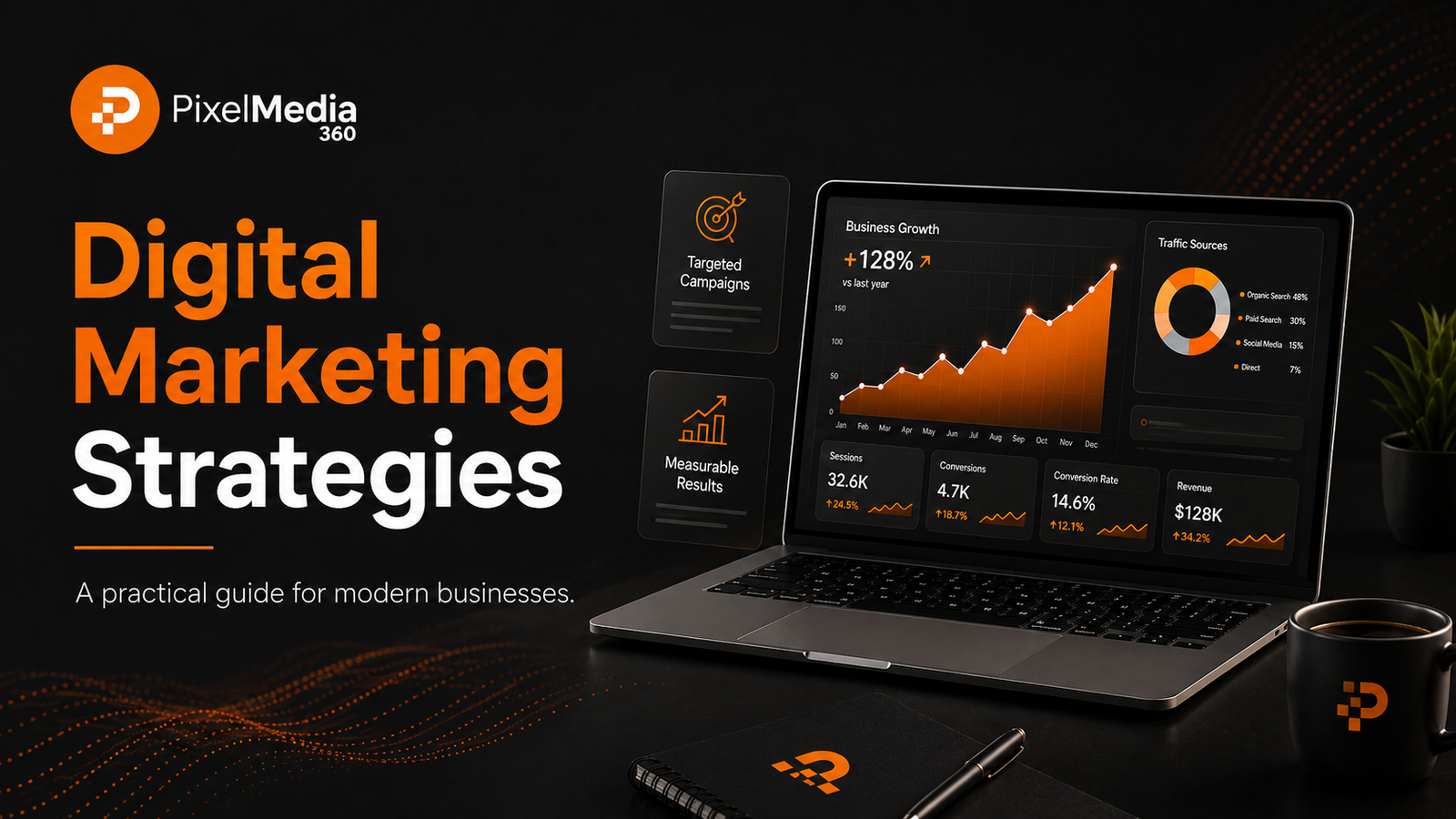
Businesses in Islamabad and Rawalpindi are competing for attention across Google Search, social media, online marketplaces, and AI-powered discovery platforms. Publishing occasional posts or running advertisements without a structured plan is unlikely to produce consistent enquiries.
The most effective Digital Marketing Strategies for 2026 combine search visibility, helpful content, local optimisation, paid advertising, strong website performance and accurate conversion tracking. The objective is not simply to attract more visitors. It is to reach relevant customers, answer their questions and guide them towards a clear action.
Table of Contents
- Build a customer-focused marketing plan
- Strengthen local SEO
- Create helpful, experience-based content
- Optimise for AI-assisted search
- Improve website performance
- Use social media strategically
- Run focused paid advertising campaigns
- Build an email marketing system
- Improve conversion rates
- Measure and refine performance
- Common mistakes
- Frequently asked questions
Why Digital Marketing Strategies Matter in 2026
Customers rarely depend on one platform before making a decision. A person may discover a business on Instagram, compare its services on Google, visit its website, read customer feedback, and then contact the company through WhatsApp.
Successful Digital Marketing Strategies connect these touchpoints. Your website, search presence, advertisements, content, and social profiles should communicate the same value proposition while directing potential customers towards one measurable conversion goal.
1. Build a Customer-Focused Marketing Plan
Begin by defining the audience you need to reach instead of promoting every service to everyone.
Document the following information:
- Target customer and location
- Main customer problem
- Relevant service or solution
- Preferred marketing channel
- Primary conversion action
- Monthly performance indicator
For example, a property consultant in Islamabad may focus on appointment bookings, while an e-commerce business may prioritise completed purchases. These businesses require different campaigns, landing pages and performance metrics.
2. Strengthen Local SEO
Local SEO helps businesses appear when nearby customers search for services in Islamabad, Rawalpindi or surrounding areas.
Start by optimising your Google Business Profile with accurate contact information, business hours, service categories, photographs and service descriptions. Keep your business name, address and phone number consistent across important directories.
Create dedicated website pages for genuine service areas rather than placing a list of cities on one generic page. A business offering a digital marketing service in Bahria Town, for example, should publish useful location-specific information about its services, process and contact options.
A professional digital marketing agency in Rawalpindi should also optimise for searches connected to Rawalpindi, Islamabad, Bahria Town, DHA and relevant nearby commercial areas without creating duplicate pages.
3. Create Helpful, Experience-Based Content
Content should answer questions customers ask before choosing a service provider.
Build articles around:
- Service comparisons
- Common customer problems
- Pricing considerations
- Step-by-step processes
- Industry-specific solutions
- Mistakes customers should avoid
Instead of publishing a general article titled “Benefits of SEO,” a software company could publish “How Long Does SEO Take for a Pakistani SaaS Website?” The second topic addresses a specific concern and attracts readers with stronger intent.
Businesses can also review how established content marketing agencies approach strategy and authority building before developing their editorial plans.
Every article should be reviewed by someone who understands the subject. Add clear examples, accurate explanations, and author information where appropriate. This supports credibility without relying on unsupported claims.
4. Optimise for AI-Assisted Search
Search behaviour is expanding beyond traditional result pages. Customers may use search engines, voice assistants or AI tools to compare services and collect recommendations.
Structure important information so that both people and search systems can understand it:
- Give direct answers near the beginning of each section.
- Use descriptive headings and concise paragraphs.
- Define technical terms clearly.
- Add relevant FAQs.
- Mention locations, services and business details accurately.
- Use structured data where technically appropriate.
Do not create large quantities of shallow AI-generated content. Human review, subject knowledge and factual accuracy remain essential.
5. Improve Website Performance and User Experience
Marketing campaigns cannot perform efficiently when the website is slow, confusing or difficult to use on a mobile phone.
Review these essential elements:
- Mobile responsiveness
- Page loading performance
- Clear service navigation
- Visible contact information
- Secure HTTPS connection
- Simple enquiry forms
- Relevant calls to action
- Accurate analytics tracking
Each major service should have a dedicated page explaining the problem, solution, process and next step. Businesses planning a redesign should prioritise professional web development services that support SEO, usability and conversions rather than appearance alone.
6. Use Social Media Strategically
A strong social media strategy is based on customer behaviour, not the number of platforms available.
Select channels according to your audience. LinkedIn may suit B2B consulting and professional services, while Instagram and Facebook may be more appropriate for restaurants, fashion brands, property businesses and consumer services.
Use a balanced content plan:
- Educational posts that answer customer questions
- Service demonstrations
- Product or process videos
- Team and workplace content
- Customer feedback with permission
- Promotional offers with clear conditions
Measure profile visits, website clicks, enquiries and qualified leads. Likes alone do not show whether social media is supporting business growth.
7. Run Focused Paid Advertising Campaigns
Paid advertising can provide faster visibility, but campaigns should be built around commercial intent.
Separate campaigns by service, audience, and location. A Google Ads campaign for web development should not send visitors to a general homepage containing unrelated services. It should direct them to a relevant landing page with a focused message.
Use negative keywords to reduce irrelevant clicks, test multiple advertisements and track calls, forms, WhatsApp enquiries or purchases. Increase spending only after confirming that conversions are genuine and commercially valuable.
8. Build an Email Marketing System
Email marketing helps businesses follow up with prospects who are interested but not ready to purchase immediately.
Create separate email groups for customers, leads, subscribers,s and previous clients. Useful campaigns may include:
- Welcome emails
- Educational email sequences
- Appointment reminders
- Service updates
- Product recommendations
- Re-engagement campaigns
Every message should provide a clear benefit and one primary action. Avoid sending the same promotion repeatedly to the entire contact list.
9. Improve Conversion Rates
Increasing website traffic is expensive when visitors do not contact the business.
Conversion rate optimization focuses on improving the percentage of visitors who take a meaningful action. Test changes such as:
- Shorter enquiry forms
- Clearer service descriptions
- More visible phone and WhatsApp buttons
- Stronger page headings
- Better mobile layouts
- Frequently asked questions near the contact section
Change one major element at a time and compare results over a meaningful period. This makes it easier to understand which adjustment affected performance.
10. Measure and Refine Performance
Marketing decisions should be based on reliable business data.
Digital Marketing Performance Checklist
| Channel | Primary Objective | Useful Measurement |
| SEO | Increase relevant search visibility | Qualified organic enquiries |
| Local SEO | Reach nearby customers | Calls, directions and local leads |
| Content | Educate and attract prospects | Engaged visits and assisted leads |
| Paid Ads | Generate immediate demand | Cost per qualified conversion |
| Social Media | Build awareness and engagement | Website visits and enquiries |
| Nurture leads and customers | Clicks, replies and conversions | |
| Website | Convert visitors | Form, call and purchase completion |
Review results monthly. Identify which channels attract qualified customers, which pages lose visitors, and which campaigns consume budget without producing meaningful outcomes.
Common Digital Marketing Mistakes to Avoid
Targeting Broad Keywords Only
Highly competitive national keywords may attract irrelevant visitors. Combine broader topics with service, audience, and location-specific searches.
Sending Every Visitor to the Homepage
Different advertisements and keywords represent different customer needs. Use dedicated landing pages whenever possible.
Publishing Content Without Search Intent
A well-written article will still underperform when it does not answer the question behind the search.
Ignoring Mobile Users
Customers may leave before reading your offer when buttons, forms or text are difficult to use on smaller screens.
Measuring Traffic Instead of Business Results
Traffic is useful only when it contributes to enquiries, bookings, purchases or another defined objective.
Changing Campaigns Too Quickly
Frequent changes make performance difficult to evaluate. Collect enough data before making major decisions.
Frequently Asked Questions
What are the most effective Digital Marketing Strategies for small businesses?
Local SEO, service-focused content, a conversion-friendly website, targeted paid advertising, and consistent follow-up are generally the strongest starting points. The correct combination depends on the audience, budget and sales process.
How much should a business spend on digital marketing?
There is no universal amount. Set a budget based on customer value, competition, campaign objectives and the number of qualified leads required. Begin with a controlled budget and increase it when tracking confirms sustainable results.
How long does digital marketing take to produce results?
Paid advertising can generate visibility quickly, while SEO and content usually require continued optimisation. Timelines depend on competition, website condition, budget, service demand and execution quality.
Should Islamabad and Rawalpindi businesses create separate location pages?
Separate pages are appropriate when the business genuinely serves both locations and can provide useful, distinct information for each audience. Avoid creating duplicate pages that only replace one city name with another.
Is AI-generated content suitable for a business website?
AI can support research, organisation and drafting, but content should be reviewed for accuracy, originality, relevance and brand tone. Sensitive or technical topics require qualified human oversight.
Should a business hire an agency or manage marketing internally?
An internal team may suit companies with sufficient expertise and resources. An agency can be useful when the business needs coordinated support across SEO, advertising, content, social media and website development.
Final Thoughts
The best Digital Marketing Strategies for 2026 are integrated, customer-focused and measurable. Businesses in Islamabad and Rawalpindi should avoid disconnected campaigns and build a system in which local SEO, useful content, paid promotion, social media and website performance support the same commercial objective.
Pixel Media 360 provides digital services that include SEO, Google Ads, website development, social media marketing, content marketing and creative brand identity. Businesses seeking a structured strategy can contact the team to discuss their audience, current digital performance, and priority growth goals.