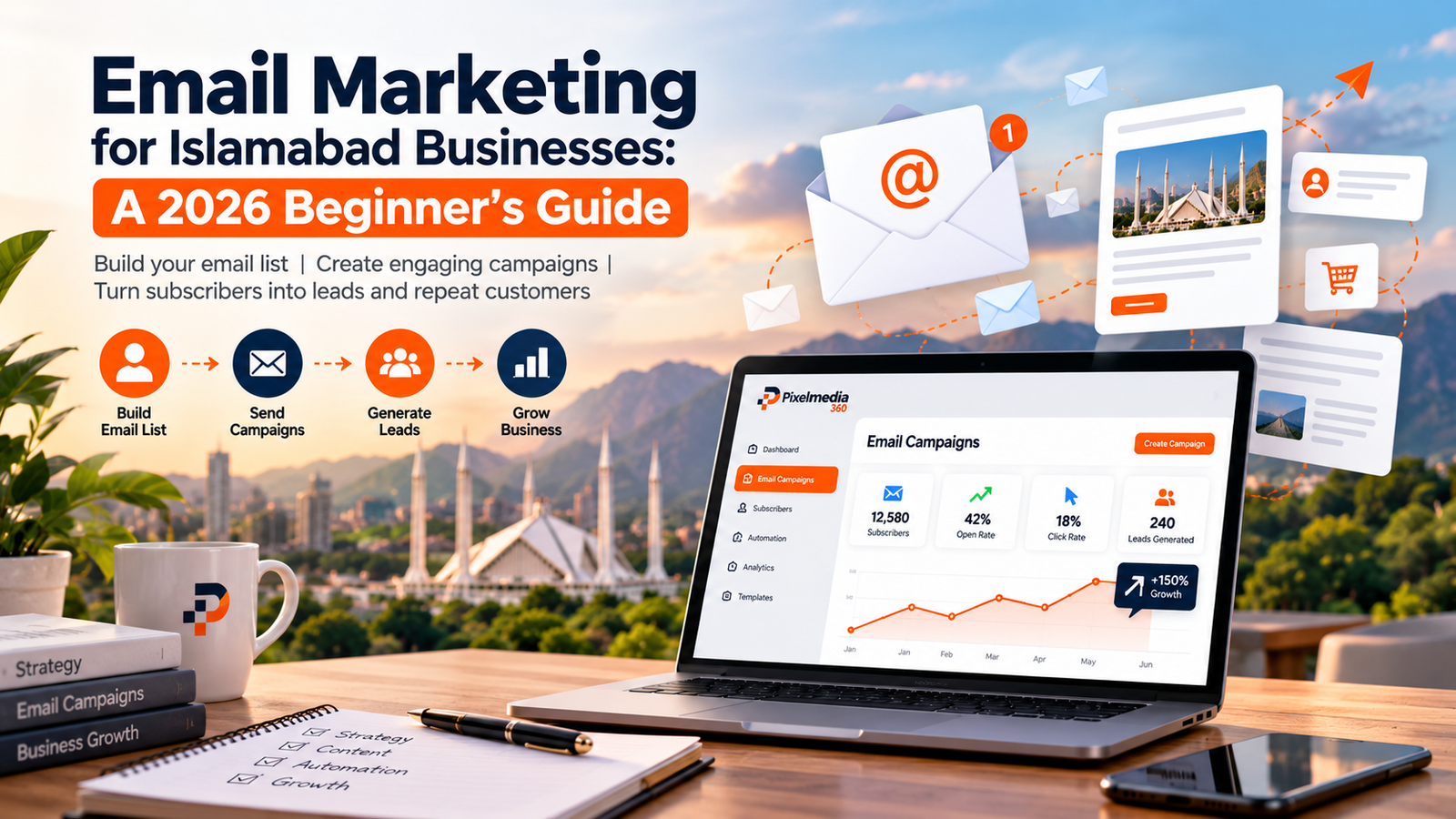


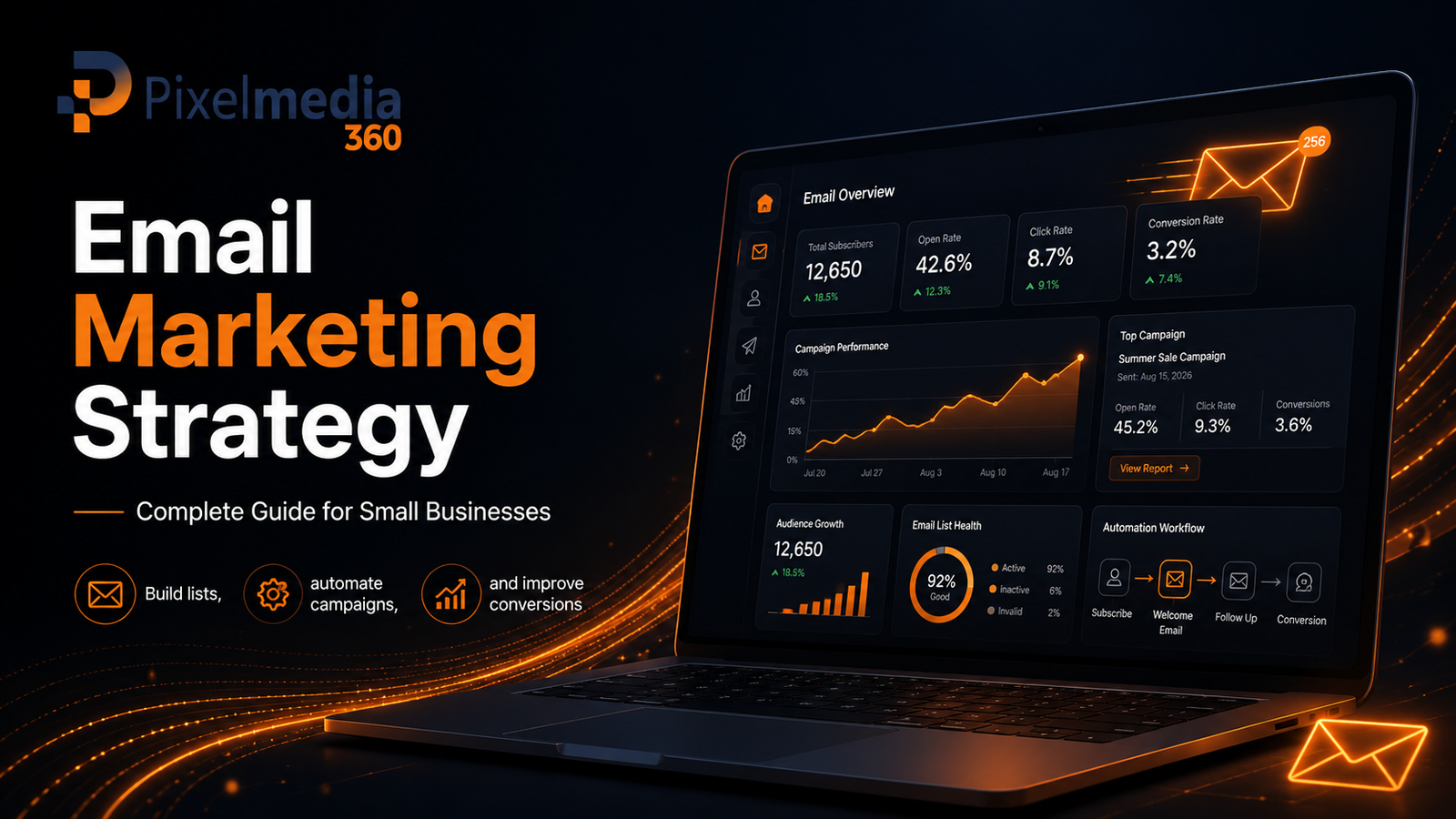
For small businesses, Email marketing works best when it is treated as a relationship channel rather than a constant stream of promotions. A good strategy helps you attract the right subscribers, send relevant messages, automate timely follow-ups, and guide people towards useful actions such as making a purchase, booking a consultation, or returning to your website.
For businesses in Islamabad, Rawalpindi, and across Pakistan, the fundamentals remain the same: build a permission-based list, segment subscribers, create useful content, automate repetitive communication, and measure what happens after every email campaign.
This guide explains how to build a practical email marketing strategy for 2026 without relying on spammy tactics, oversized mailing lists, or unnecessary automation.
Table of Contents
- Why Email Marketing Matters for Small Businesses
- How to Build an Email Marketing Strategy
- Define Your Email Marketing Goals
- Build a Quality Email List
- Segment Your Subscribers
- Create Effective Email Campaigns
- Use Email Marketing Automation
- Follow Email Marketing Best Practices
- Track and Measure Email Performance
- Practical Email Marketing Examples
- Common Email Marketing Mistakes
- Frequently Asked Questions
- Final Thoughts
Why Email Marketing Still Matters for Small Businesses
Email gives a business a direct way to communicate with people who have chosen to hear from it. Unlike an audience that exists only on a social platform, an email list can become a long-term customer communication asset when it is collected and managed responsibly.
For a small business, email can support several goals:
- Nurturing new leads
- Promoting products or services
- Sharing educational content
- Following up after enquiries
- Recovering abandoned carts
- Re-engaging previous customers
- Announcing launches or events
- Building repeat customer relationships
The important distinction is relevance. Sending the same promotional message to every subscriber is rarely a strong email marketing strategy.
Modern email platforms allow businesses to segment contacts by interests, location, purchase activity, or other available data, helping them send more relevant content to smaller groups.
How to Build an Email Marketing Strategy in 2026
1. Define One Clear Goal Before Sending
Every campaign should have a reason to exist.
Before writing the subject line, decide what action you want the subscriber to take.
Possible goals include:
- Read a new guide
- Request a quotation
- Book a consultation
- Purchase a product
- Register for an event
- Return to an abandoned cart
- Explore a new service
An educational newsletter and a sales-focused email marketing campaign should not be written in exactly the same way.
If the objective is lead nurturing, the email may provide useful information before asking for a consultation. If the objective is an ecommerce sale, product relevance, timing, and a clear purchase path become more important.
Pixel Media 360 includes email campaigns within its broader content marketing services, alongside content strategy, copywriting, and other brand communication activities.
2. Build an Email List With Permission
Strong email list building starts with people who genuinely want to receive your communication.
Useful signup opportunities may include:
- Website newsletter forms
- Lead-magnet landing pages
- Account registration
- Event registration
- Checkout opt-ins
- Consultation forms
- Downloadable guides
- In-store signup opportunities
Avoid purchasing random email databases.
Mailchimp’s current guidance recommends securing permission before sending marketing email and keeping a record of how contacts joined the list. It also states that third-party purchased lists violate its terms.
A smaller list of interested subscribers is generally more useful than a large database containing people who never requested your emails.
3. Segment Subscribers Instead of Sending Everything to Everyone
Segmentation helps businesses send different messages to different groups.
A Rawalpindi retailer, for example, could separate:
- First-time subscribers
- Existing customers
- Repeat buyers
- Customers interested in a specific product category
- People who have not purchased recently
A service business in Islamabad could separate:
- New leads
- Existing clients
- Leads interested in specific services
- Previous consultation requests
- Newsletter subscribers
The objective is simple: send information that makes sense for the recipient.
Email platforms can use subscriber profiles, audience fields, ecommerce activity, and other available data to create targeted segments.
4. Plan the Right Email Campaign Types
A complete strategy normally uses more than one type of email.
| Email Type | Main Purpose | Typical Action |
| Welcome email | Introduce the brand | Explore products or services |
| Newsletter | Educate and stay visible | Read content |
| Promotional email | Present an offer | Purchase or enquire |
| Lead nurture email | Build consideration | Request consultation |
| Abandoned cart email | Recover incomplete orders | Complete purchase |
| Re-engagement email | Reconnect with inactive users | Return to website |
These are email marketing examples of different purposes, not a requirement to use every format.
Start with the campaigns most closely connected to your business goals.
5. Write Emails Around One Main Message
A common problem is trying to fit five different messages into one email.
A stronger email normally has:
- A clear subject line
- A short opening
- One primary message
- Supporting information
- One main call to action
- A clear sender identity
- An unsubscribe option
The subject line should accurately represent the content. Gmail’s sender guidelines specifically advise against misleading subject lines, display names, or headers.
Keep the copy easy to scan, especially for mobile users.
Instead of:
Click here
use descriptive CTA text such as:
View the new collection
Book a consultation
Read the complete guide
Mailchimp also recommends descriptive link text rather than generic “click here” wording because it gives recipients clearer context.
6. Match the Email With the Landing Page
The email is only part of the customer journey.
If someone clicks an email about a specific service, they should not land on a generic homepage and have to search for it again.
The landing page should continue the same message, offer, and next step.
For example:
Email: Book a website copy consultation
Landing page: Website copywriting service with benefits, process, and enquiry form
Businesses improving the post-click experience can review Pixel Media 360’s website copywriting services to see how service-focused website messaging can support conversion paths.
7. Use Email Marketing Automation Where It Adds Value
Email marketing automation is most useful for messages triggered by predictable customer actions.
Useful automations may include:
- Welcome sequences
- Lead follow-ups
- Abandoned cart reminders
- Post-purchase emails
- Customer re-engagement
- Birthday or anniversary emails
- Event reminders
For example, an ecommerce store can trigger an abandoned cart email when a shopper begins checkout but does not complete the order. Current email platforms support automated workflows based on actions such as signup, purchase, and cart abandonment.
Automation should make communication more timely—not make it impersonal.
Review automated emails regularly. Offers change, services change, links expire, and customer expectations evolve.
8. Protect Email Deliverability
Good copy means little if emails consistently reach spam folders.
Businesses using their own domain should take email authentication seriously.
Google currently requires senders to Gmail accounts to use SPF or DKIM authentication. Senders delivering more than 5,000 messages per day to Gmail accounts face additional requirements, including SPF, DKIM, DMARC, and one-click unsubscribe for marketing and subscribed messages.
Practical email marketing best practices include:
- Send only to people who requested your emails
- Authenticate the sending domain
- Remove repeatedly bouncing addresses
- Make unsubscribing easy
- Avoid misleading subject lines
- Monitor spam complaints
- Keep sender information clear
- Review inactive subscribers periodically
Deliverability is not only a technical issue. Poor list quality can damage sender reputation too.
9. Measure More Than Open Rates
A professional email marketing campaign should be evaluated according to its objective.
Useful metrics may include:
- Delivery rate
- Click rate
- Unsubscribe rate
- Bounce rate
- Website sessions
- Form submissions
- Purchases
- Revenue
- Consultation requests
Open rates can provide context, but they should not be treated as the only success metric.
If the goal was to generate consultation requests, the number of qualified enquiries matters more than simply recording email opens.
Mailchimp recommends reviewing campaign reports, testing subject lines, segmentation, frequency, and content based on actual audience response.
Practical Email Marketing Examples
Example 1: Local Service Business
A Rawalpindi service company collects email addresses through a consultation form.
A simple sequence could be:
- Confirmation and useful introductory information
- Educational email answering a common customer question
- Relevant service explanation
- Consultation CTA
The purpose is not to send repeated sales messages. It is to help the lead understand the service before making a decision.
Example 2: Ecommerce Business
An Islamabad-based online store could combine:
- Welcome email
- New-product updates
- Category-based promotions
- Abandoned cart automation
- Post-purchase follow-up
Customers interested in one product category should not automatically receive every promotion the store runs.
Common Email Marketing Mistakes to Avoid
Buying Email Lists
Purchased contacts have not necessarily asked to hear from your business. This can create engagement, reputation, and platform-compliance problems.
Sending the Same Email to Everyone
Different customers have different interests and stages in the buying journey.
Over-Automating Communication
Automation should support relevant communication, not create endless sequences that recipients no longer find useful.
Using Weak Calls to Action
Readers should understand what happens when they click.
Ignoring Mobile Users
Long paragraphs, tiny buttons, and complicated layouts make emails difficult to use on smaller screens.
Tracking Opens but Ignoring Business Results
Measure the action connected to the campaign goal.
Frequently Asked Questions
What is email marketing?
Email marketing is the use of permission-based email communication to educate, nurture, promote, or maintain relationships with subscribers and customers.
Is email marketing suitable for small businesses?
Yes. Email marketing for small business can support lead nurturing, customer retention, ecommerce sales, content distribution, and repeat communication when the audience and campaign goals are clearly defined.
What are the best email marketing tools?
The right email marketing tools depend on list size, automation requirements, ecommerce integrations, segmentation needs, reporting, and budget. Compare platforms based on the features your business will actually use rather than choosing solely by the number of available features.
How often should a business send marketing emails?
There is no universal frequency. Test a schedule that matches your audience and the value of the content. Sending too frequently can create fatigue, while disappearing for long periods can weaken recognition.
Should small businesses use email automation?
Yes, when there is a clear trigger and purpose. Welcome messages, lead follow-ups, abandoned carts, and post-purchase communication are common automation opportunities.
How can I grow my email list?
Use clear signup forms, useful lead magnets, checkout opt-ins, website forms, events, and other permission-based methods. Explain what subscribers will receive rather than asking for an email address without context.
Build an Email Strategy Around Relevance, Not Volume
Successful email marketing is not about sending the highest number of messages. It is about reaching the right people with useful communication at the right stage of their relationship with your business.
Start with permission-based email list building, create clear audience segments, plan campaigns around specific goals, use automation where it improves timing, and measure the actions that matter to the business.
For small businesses in Islamabad, Rawalpindi, and across Pakistan, a focused strategy can make email a practical part of a wider digital marketing system rather than an isolated promotional channel.
If you need help planning content, customer journeys, or digital campaigns around your business goals, contact Pixel Media 360 to discuss your project requirements.